 Skip to content


The Science of Sparkle: Why You Can't Judge a Diamond in a Setting
You walk into a jewelry store, fall in love with a ring, and ask the jeweler about the diamond. They tell you it is a G color, SI1 clarity. But something looks slightly yellow. The sparkle seems a little muted. You wonder — is it the lighting in here, or is something off with the stone?
The answer is almost always the setting. When you buy a certified loose gemstone from Databazaar, you see exactly what you are getting — no prongs, no halos, no metal color interference — before a setting ever touches the stone.
Here is the science behind why a setting hides more than you think.
How Prongs Hide What You Need to See
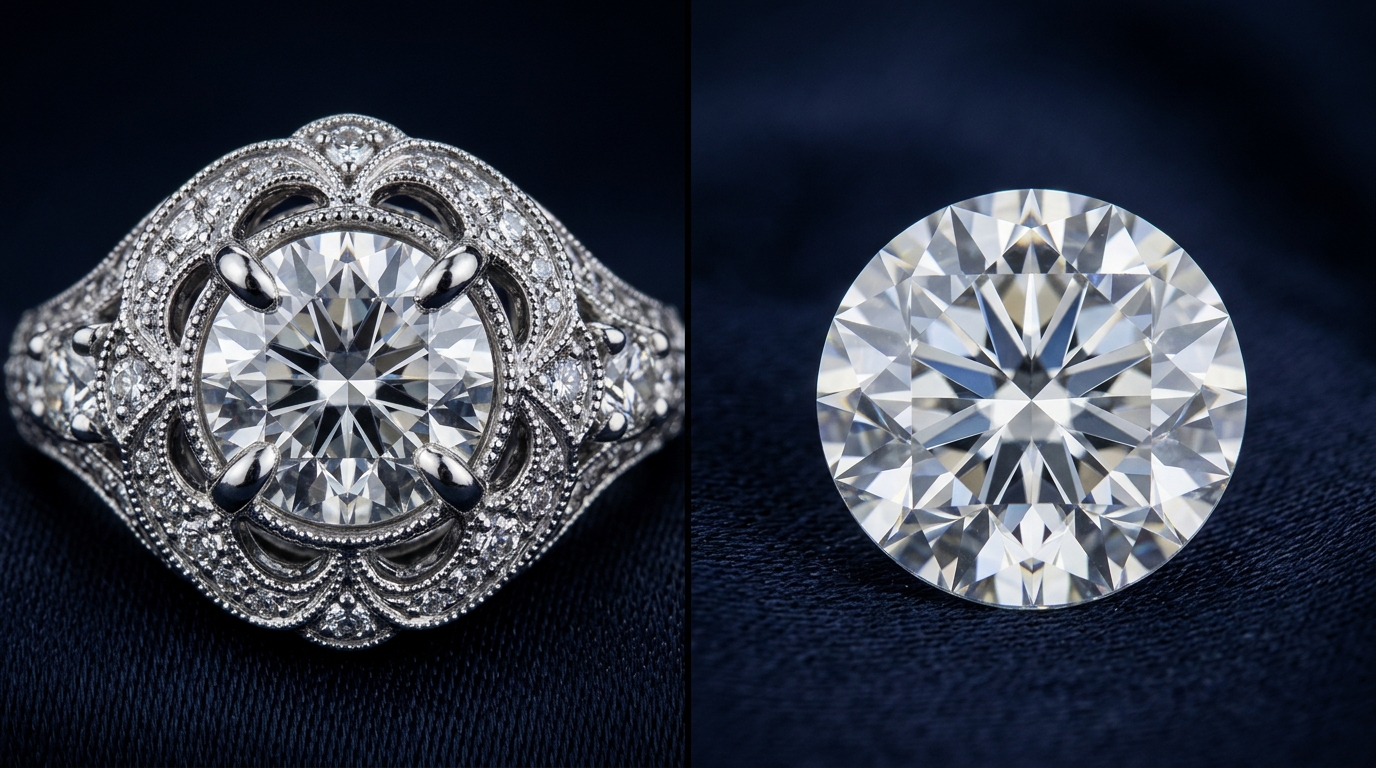
The average round brilliant diamond is held in place by four to six prongs. These prongs sit directly on the girdle — the widest edge of the stone. This is also one of the most common locations for chips, naturals, and clarity characteristics that affect a diamond's grade.
Experienced jewelers know this. Prongs are sometimes deliberately placed over inclusions or chips to conceal them. The result: a stone graded SI1 on paper that shows visible characteristics once removed from the setting. Buying loose means you examine the girdle, the culet, the table — every surface — under magnification before any metal gets near it.
When you buy loose gemstones online in the USA, the certificate tells the full story. The prongs have not been written yet.

The Metal Color Problem
Diamond color is graded D through Z — D being perfectly colorless, Z being light yellow. The difference between a G and an H, or an H and an I, is subtle when viewed face-up in isolation. But metal amplifies everything.
Yellow gold reflects warmth directly into the diamond. A G-color stone set in yellow gold can appear two full grades warmer — looking more like an I or J to the naked eye. White gold and platinum are neutral and will show the stone's true color more accurately. Rose gold creates its own warm cast.
When you evaluate a certified loose diamond under consistent neutral lighting, you see its actual color grade — not a reflection of whatever metal it happens to be sitting in. That is the only honest assessment.
How Halos Create the Illusion of Size and Quality
Halo settings are one of the most effective visual tricks in jewelry retail. A ring of smaller diamonds surrounding the center stone makes the center appear significantly larger than its carat weight. The halo also creates an optical frame of brilliance that draws the eye outward — away from any characteristics in the center stone.
A 0.70ct center stone in a well-designed halo setting can appear as large as a 1.00ct solitaire. The price difference between those two stones is substantial. Many buyers are paying solitaire prices for halo illusions — without realizing it.
Buying a certified loose stone removes the illusion entirely. You know exactly what carat weight you are purchasing before a single accent diamond is placed around it.
What Consistent Lighting Actually Reveals
Jewelry stores are lit for maximum sparkle — not for accurate evaluation. High-intensity directional lighting makes every diamond look brilliant. Inclusions become invisible. Color grades appear better than they are. This is not accidental.
The GIA grades diamonds under standardized, controlled lighting conditions for exactly this reason. The only way to evaluate a stone the way GIA does is to examine it loose, under neutral daylight-equivalent illumination, with a loupe or microscope — not under a showroom spotlight set in a gold ring.
At Databazaar, every stone comes with its certificate of authenticity. You know the grades before the stone arrives. And when it arrives loose, you can verify them yourself before it goes anywhere near a setting.
The Smart Buyer Approach: Loose First, Setting After
The most informed jewelry buyers in the world buy the stone first and the setting second. This is how it has always been done at the highest levels of the market — and it is now accessible to every buyer through Databazaar's certified loose gemstone collection.
The process is straightforward:
Browse certified loose gemstones — filter by stone type, carat weight, and quality
Your stone ships from within the USA — delivered in 5 to 10 business days with certificate of authenticity included
Examine it yourself in natural light — verify it matches the certificate
Take it to any jeweler in the USA — or send it to your preferred jeweler — and have it set exactly how you want
Not sure which stone is right for you? Use the free gemstone recommendation tool — get a matched recommendation in under a minute.
Frequently Asked Questions
Why is it hard to judge a diamond's quality when it is set in a ring?
Prongs, halos, pave bands, and metal color all interfere with how you perceive a diamond's true color, clarity, and brilliance. The only way to judge a diamond objectively is to examine it loose, under consistent neutral lighting, before any setting touches it.
What is a loose diamond?
A loose diamond is a certified stone sold without a ring or setting. It comes with a certificate of authenticity confirming its carat weight, cut, color, and clarity grades. You buy the stone first, then have it set by any jeweler of your choice.
Can a setting hide inclusions in a diamond?
Yes. Prongs are often deliberately placed over chips or inclusions near a diamond's girdle. Halo settings surround the center stone with smaller diamonds that distract the eye from the main stone's clarity characteristics. Buying loose lets you see exactly what you are getting.
Does metal color affect how a diamond looks?
Yes, significantly. Yellow gold reflects warmth into a diamond, making a near-colorless stone appear more yellow than its grade. White gold and platinum are neutral and show the stone's true color. Always examine a loose stone under neutral lighting for an accurate read.
Where can I buy a loose diamond in the USA?
Databazaar sells certified loose diamonds and gemstones shipped from within the USA. Every stone comes with a certificate of authenticity, delivered in 5 to 10 business days.
Why should I buy a loose diamond instead of a pre-set ring?
Buying loose gives you full transparency. You inspect the stone before any setting conceals its characteristics. You pay for the diamond's actual quality — not a jeweler's combined markup — then have it set exactly how you want.
How do halos affect the appearance of a center diamond?
Halo settings make a center stone appear larger than its actual carat weight. They also create a frame of brilliance that can mask lower color or clarity in the center stone. Buying loose removes the illusion entirely.
Are certified loose gemstones available in the USA?
Yes. Databazaar stocks over 7,000 certified natural loose gemstones in the USA — diamonds, rubies, sapphires, emeralds, and more — all shipping domestically in 5 to 10 business days with a certificate of authenticity included.