 Skip to content


5 Best Lab Grown Diamond Engagement Rings to Consider
Table of Contents
- Why Lab Grown Diamond Rings Belong on Your Shortlist
- How We Compared the 5 Best Lab Grown Diamond Engagement Rings
- Lab-Grown Versus Mined Diamond Engagement Rings: What Actually Changes
- How to Choose a Lab-Grown Diamond Without Regrets
- Lab-Grown Diamond Ring Settings: Solitaire, Halo and Split-Shank
- Best Lab-Grown Diamond Brands and Retailers to Buy From
- Total Cost of Ownership and After-Purchase Policies
- Conclusion
- Frequently Asked Questions
Last Updated: October 19, 2026
Why Lab Grown Diamond Rings Belong on Your Shortlist
Lab grown diamonds are real diamonds, grown in a lab from a carbon seed, and they now dominate how buyers think about engagement rings. According to BriteCo's Jewelry, Diamond, & Watch Price Index, lab-grown stones appeared in 51% of newly appraised engagement rings from January through June 2026. That is a majority, not a niche.
This guide from Databazaar treats the category the way a jeweler would: by grading, setting, metal, and policy.
Here is the tension most roundups skip. A lab-grown stone can look identical to a mined one and still carry a fraction of the resale story. So the question is not whether lab-grown is "real." It is whether the ring you choose holds up on the hand, in the light, and under a loupe.
How We Compared the 5 Best Lab Grown Diamond Engagement Rings
When comparing lab-grown diamond engagement rings, consider these five criteria:
- Diamond quality: cut grade first, then color and clarity, judged on a grading report from an independent lab
- Setting build: prong thickness, gallery height, and how the head is anchored to the band
- Metal: 14K gold, white gold, or platinum, with the trade-offs of each
- Wear and durability: snag risk, cleaning access, and how the setting ages with daily use
- After-purchase terms: returns, resizing, and warranty in plain language
Ring Pick |
Style |
Best For |
What to Verify |
|---|---|---|---|
The Classic Solitaire |
Four-prong solitaire |
Buyers who want maximum stone focus |
Prong thickness and head security |
The Halo Cushion |
Halo setting |
Smaller carat weights that read larger |
Halo stone matching and pave quality |
The Split-Shank Oval |
Split-shank |
Finger coverage and a modern profile |
Shank flex and solder points |
The Cathedral Round |
Cathedral setting |
High-set stones needing clearance |
Gallery height and snag risk |
The Three-Stone |
Multi-stone design |
Buyers who want a wider spread |
Stone proportion and symmetry |
Pro TipAsk for the grading report number before you fall in love with a photo. A jeweler who can send the report number and the lab's verification link within minutes is a jeweler worth buying from.
Lab-Grown Versus Mined Diamond Engagement Rings: What Actually Changes
The stone is the same mineral. What changes is origin, cost structure, and the resale market. A lab-grown diamond is a diamond grown above ground using high pressure and heat or chemical vapor deposition, with the same optical and physical properties as a mined stone.
The practical differences buyers feel:
- Price: lab-grown stones cost less at the same carat and quality, which frees budget for a better cut or a larger spread
- Resale: mined diamonds hold a resale market that lab-grown stones largely do not, so treat a lab-grown purchase as a keepsake, not an asset
- Sourcing: lab-grown avoids mining, which is why conscious buyers lean toward it
- Supply: lab-grown production is expanding, and prices have softened as capacity grows
That last point matters for anyone comparing lab-grown versus mined diamond engagement rings on price alone. A softer market rewards buyers who choose quality over size.
How to Choose a Lab-Grown Diamond Without Regrets
Choosing a lab-grown diamond comes down to four numbers and one document. Get the cut right, accept a slightly lower color and clarity grade, and insist on an independent grading report.
- Cut is the only grade that changes brilliance. Prioritize excellent cut over everything else.
- Color: near-colorless grades look white in most settings; warmer grades hide well in yellow gold.
- Clarity: eye-clean is the goal, not flawless. Inclusions you cannot see at arm's length do not matter.
- Carat: spread matters more than weight. An elongated shape reads larger at the same carat.
- Report: a grading report from an independent lab is the only verification that counts.
Watch OutSkipping the grading report to save time is the most common mistake in this category. Without an independent report, you have no way to confirm the stone matches its description, and a return becomes a negotiation instead of a right.
Lab-Grown Diamond Ring Settings: Solitaire, Halo and Split-Shank
The setting decides how the ring wears, not just how it looks. Two rings with the same center stone can differ by millimeters in gallery height and prong thickness, and those millimeters decide whether the ring snags on a sweater or survives a decade of daily use.
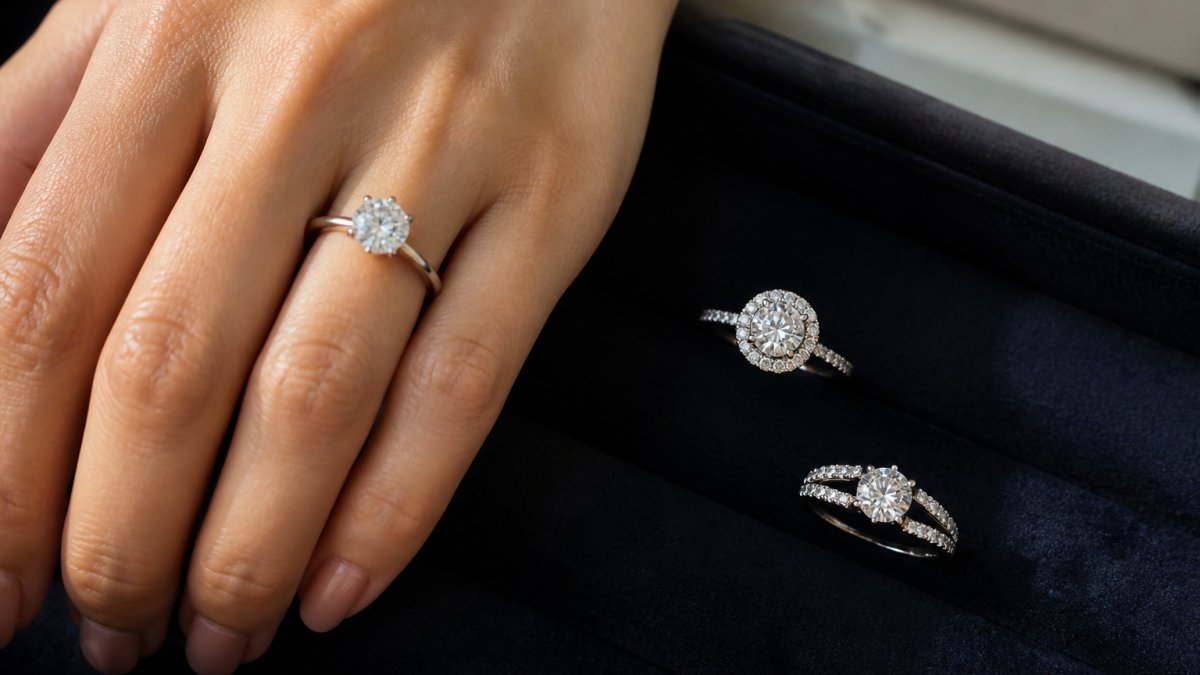
Consider how common settings behave on the hand, judged on the mechanics that matter rather than the silhouette alone.
- Solitaire (four-prong): Fewest parts and fewest failure points, and the easiest head to clean because the gallery is open on all sides. The trade-off is that a thin four-prong head puts the girdle of the stone close to the surface, so prong thickness and tip shape are the whole game. Ask for prong tips that are rounded and thick enough to cover the girdle; needle-thin tips are the most common cause of a lost stone.
- Halo setting: A ring of small stones around the center makes a modest carat weight read larger, but the halo is a maintenance commitment. The small stones sit in their own prongs or a shared bead setting, and each one is a place for lint, lotion, and snagging. Check that the halo stones match the center in color and that the halo sits low enough not to catch on fabric.
- Split-shank setting: The band divides before it meets the head, which widens finger coverage and adds a modern profile. The weak point is the point where the two shanks rejoin: that solder joint takes repeated stress every time the ring is put on or removed. Ask how the joint is finished and whether the shanks are soldered or cast as one piece.
- Cathedral setting: The head rises from the band on an arch, giving tall stones clearance and a classic silhouette. The arch raises the center of gravity, so a cathedral ring is more likely to rotate on the finger and to knock against door frames. It is a beautiful choice for a low-activity wearer and a snag risk for anyone who works with their hands.
- Knife-edge band: A raised center ridge that catches light along the shank. It looks sharp in photos but the ridge is a wear surface, and a thin knife-edge band can feel uncomfortable between the fingers over a long day.
For buyers weighing lab-grown diamond ring settings, durability should break ties. A high cathedral head looks dramatic and snags on knitwear; a low six-prong solitaire looks quieter and survives more. The practical test is simple: run a fingernail along the underside of the head and the inside of the shank. If you feel a sharp edge or a gap where fabric can catch, you have found the ring's future maintenance bill.
Pro TipAsk the jeweler for the gallery height in millimeters and the prong thickness at the tip. A ring that sits lower than about 6 mm above the finger is generally easier to wear daily, while a head above 8 mm needs more clearance and more care.
Best Lab-Grown Diamond Brands and Retailers to Buy From
When choosing a lab-grown diamond retailer, transparency is key. Look for retailers that publish grading reports, show real product photography, and state return terms clearly.
When comparing retailers, consider the following framework:
- Grading report access: Can the retailer send the report number and the lab's verification link before you buy? A report you can look up independently is the only claim that counts.
- Photography honesty: Are the photos of the actual stone, or a representative image? Ask for a video of the specific stone under neutral light.
- Return window and conditions: Confirm the window in days, whether it applies to sized or customized rings, and who pays return shipping.
- Resizing and warranty terms: Ask how many resizes are included, what the warranty covers (prong tightening and stone loss specifically), and whether the warranty survives a resize.
- Financing and payment terms: Compare the financing partner, the minimum order, and whether paying in full changes the return terms.
Databazaar has sold fine jewelry online since 1999 and carries certified diamonds alongside its jewelry collections. The storefront pairs flat-rate shipping, 15-day returns, and live voice support with Affirm financing on orders over $50, which matters when a ring purchase needs to be spread across payments.
Compare them on the same five criteria above rather than on the strength of a magazine mention.
What most guides miss is that a brand's return window matters more than its Instagram feed. A ring is a fit-sensitive purchase, and a retailer that makes returns easy is effectively offering you a try-on period.
Watch OutA grading report number is not the same as a verification link. Ask for the link to the lab's own lookup page and confirm the report matches the stone's carat, color, clarity, and measurements before the return window closes.
Total Cost of Ownership and After-Purchase Policies
Total cost of ownership is the number most buyers never calculate, and it is where a cheap ring gets expensive. The purchase price is only the first line.
- Resizing: a ring that cannot be resized cheaply is a liability if the fit changes.
- Rhodium plating: white gold needs re-plating over time to keep its bright finish; platinum does not.
- Insurance: a ring worth insuring needs an appraisal, which needs a grading report.
- Returns: confirm the window and whether it applies to sized or customized rings.
- Warranty: ask what it covers, specifically prong tightening and stone loss.
Key TakeawayThe cheapest ring on the page is rarely the cheapest ring to own. Budget for resizing, plating, and insurance before you compare prices.
Conclusion
The hard part of buying a lab-grown engagement ring is not finding one. It is comparing five rings that look alike on a screen and telling which one is built to last a decade of daily wear.
Start with the grading report, then the setting build, then the return terms. Databazaar carries certified diamonds and fine jewelry with flat-rate shipping, 15-day returns, live voice support, and Affirm financing on orders over $50, so the comparison happens with real terms in front of you. Explore the Lab-Grown Diamond Jewelry collection and choose a ring you can verify, not just admire.
Frequently Asked Questions
Are lab-grown diamonds a good choice for an engagement ring?
Yes, for most buyers. Lab-grown diamonds are real diamonds with the same hardness and brilliance, so they hold up to daily wear. BriteCo's 2026 price index found lab-grown stones in 51% of newly appraised engagement rings from January through June 2026, which shows how quickly they have become mainstream. The main trade-off is resale: lab-grown stones resell for far less than mined ones. If you plan to keep the ring, that matters little. If you may trade up later, ask about the retailer's upgrade policy before you buy.
How can you compare lab-grown diamond engagement rings fairly?
Compare like for like. Match carat weight, cut grade, color and clarity across every ring you shortlist, then compare the grading reports side by side. A 1-carat stone graded by an independent lab is not the same as one graded in-house by the seller. Ask which lab issued the report and whether the certificate number can be verified online. Then add up the setting metal, shipping and any resizing fees so you compare total cost, not just the diamond price.
What should you look for in a lab-grown diamond ring setting?
Start with how you wear rings. A solitaire setting keeps the stone front and center and is the easiest to clean. Halo settings add apparent size but have more small stones that can loosen. Split-shank settings look wider on the finger without extra weight. Check the band thickness and whether the prongs are rounded or snag-prone. Platinum and 14K white gold both suit daily wear; platinum resists scratches better over decades, while 14K gold costs less upfront.