 Skip to content


What Is a GIA Diamond Certificate? 2026 Guide
Table of Contents
- What Is a GIA Diamond Certificate and Why It Matters
- Diamond 4Cs Explained: What the GIA Actually Grades
- How to Read a GIA Diamond Report Line by Line
- GIA vs IGI Diamond Grading: Key Differences That Affect Value
- How to Verify a GIA Diamond Certificate Online
- GIA Report vs. Appraisal: Why You Need Both for Insurance
- Common Misconceptions About Certified Diamonds
- Frequently Asked Questions
Last Updated: September 27, 2026
What Is a GIA Diamond Certificate and Why It Matters
A GIA diamond certificate is an independent grading document issued by the Gemological Institute of America that records a diamond's measured quality. This guide from Databazaar explains what that document actually proves, what it does not, and how to use it before you buy.
The term itself is a misnomer. The GIA issues grading reports, not certificates or appraisals. That distinction matters because a report describes the stone; it does not assign a monetary value. According to the GIA's official report documentation, each report carries a unique number tied to that specific diamond.
Why should a buyer care? Because a grading report is the closest thing the trade has to an objective evaluation. Without one, you are relying on a seller's word about color, clarity, and carat weight. With one, a third party has already measured the stone under controlled conditions.
Databazaar has offered certified diamonds, and the questions we field most often are not about the 4Cs. They are about trust: how do you know the paper matches the stone?
Certificate vs. Grading Report: Clearing Up the Misnomer
A diamond certificate and a grading report are the same document, and neither is a legal certificate of ownership or value. The industry simply adopted "certificate" as shorthand decades ago, and the word stuck.
What the report contains is a technical description: carat weight, color grade, clarity grade, cut grade, and the measurements behind them. What it does not contain is a price, an insurance figure, or a guarantee that you paid a fair amount.
Watch Out
Sellers who describe a "certificate" as proof of value are misusing the term. A grading report states quality, not worth. If a listing leans on the word "certificate" to justify a price, ask to see the actual report number.
Diamond 4Cs Explained: What the GIA Actually Grades
The 4Cs are carat weight, color, clarity, and cut, and the GIA grades each one on a defined scale. Carat is a weight measurement, color runs from D (colorless) downward, clarity runs from Flawless downward, and cut grades how well the diamond interacts with light.
Cut is the one buyers underestimate. A diamond with excellent color and clarity but a poor cut can look dull next to a lower-graded stone with better proportions. The GIA evaluates cut using measurements like table percentage, depth percentage, polish, and symmetry, all of which describe the diamond's anatomy and facet arrangement.
| Factor | What It Measures | Why It Matters |
|---|---|---|
| Carat weight | Physical weight in carats | Affects size and price |
| Color grade | Absence of color (D to Z) | Visible tint at lower grades |
| Clarity grade | Internal and surface flaws | Affects brilliance and value |
| Cut grade | Light performance and proportions | Drives how bright it looks |
Cut Grade, Polish, and Symmetry: The Light Performance Factors
Cut grade is the only C the GIA assigns based on how the diamond behaves, not just how it looks under a loupe. Polish describes the smoothness of the facet surfaces, and symmetry describes how precisely those facets align.
Both feed into light performance.
How to Read a GIA Diamond Report Line by Line
Start at the top: the report number, the shape and cutting style, and the measurements. From there, work down through the grading results, then the proportions diagram, then the clarity characteristics plot.
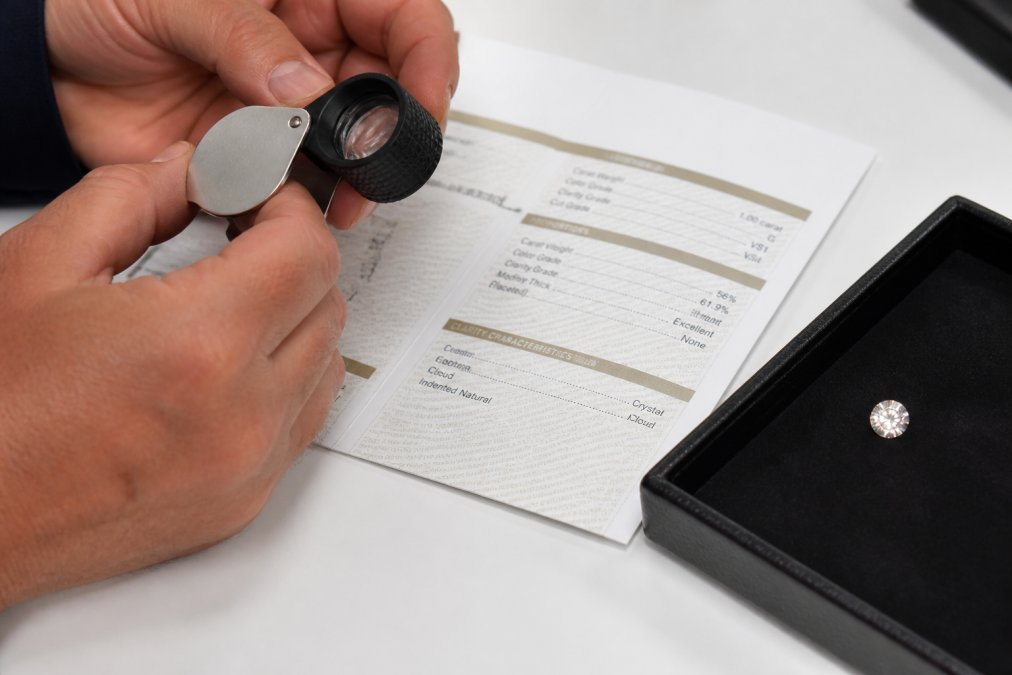
Decoding the Laser Inscription on the Girdle
The girdle is the thin band around a diamond's widest point, and the GIA inscribes the report number there using a laser. Under magnification, that number should match the report exactly.
GIA vs IGI Diamond Grading: Key Differences That Affect Value
GIA and IGI are both legitimate gemological laboratories, but their reports are not interchangeable in the marketplace. The differences show up in three places: how strict the grading scales are applied, what the report actually covers, and how the secondary market prices the result.
Watch Out
A seller who quotes a grade without naming the lab is giving you half the information. Ask for the report number and the issuing laboratory before you discuss price.
How to Verify a GIA Diamond Certificate Online
Verification is the single most useful thing you can do before buying a diamond, and almost no guide walks you through it end to end. Here is the actual process.
- Recycled numbers. A real report number from a real diamond is copied onto a fake report and paired with a different, lower-quality stone. The number verifies online, but the stone does not match the returned data. This is why Step 4 matters as much as Step 3.
- Screenshot-only sellers. Anyone can photograph a report. A screenshot proves nothing. If a seller will not give you the number so you can run it yourself, walk away.
- Lookalike verification pages. Fake sites mimic the GIA Report Check interface and return fabricated results. Always type the GIA address manually.
- Missing or altered inscriptions. If the girdle inscription is absent on a stone the seller claims is GIA-graded, ask why. Some older stones were never inscribed, and some owners request removal, but the default expectation for a modern GIA report is that the number is on the stone.
Digital vs. Physical Reports: What to Check
Digital reports are increasingly common and fully legitimate. The GIA issues them through its online portal, and they carry the same grading data as a printed copy. The report number is the same, and the Report Check tool returns the same results.
Pro Tip
Ask the seller for the report number before you ask for photos. Running the number yourself takes less time than reading a listing, and it tells you whether the stone is worth a closer look.
Key Takeaway
A report that verifies online proves the number is real. It does not prove the stone in front of you is the stone that number belongs to. You need both the online check and the girdle inscription match to close that gap.
GIA Report vs. Appraisal: Why You Need Both for Insurance
A grading report and an appraisal serve different purposes, and insurers typically want the appraisal. The report establishes what the diamond is; the appraisal establishes what it is worth to replace.
Key Takeaway
A GIA report without an appraisal leaves you underinsured. An appraisal without a report leaves you with a number and no proof of what it describes.
Common Misconceptions About Certified Diamonds
The biggest misconception is that a certified diamond is automatically a good diamond. Certification describes quality; it does not guarantee quality. A certified stone can still be a poor value if the cut is weak or the price is inflated.
Frequently Asked Questions
Is a GIA diamond certificate worth it?
Yes, for any diamond purchase where value depends on verified quality. A GIA diamond certificate comes from an independent gemological laboratory that does not buy or sell diamonds, so its grading is an unbiased analysis rather than a sales pitch. Without one, you rely on the seller's word about color grade, clarity grade, and carat weight. The report also gives you a verification number you can check online, which protects resale value and helps insurers confirm what they are covering.
How much does a GIA cert cost?
GIA fees depend on the diamond's size, the type of report requested, and current turnaround times, so there is no single flat rate. A Diamond Dossier for smaller stones costs less than a full report with a plotted diagram for larger ones. Many retailers absorb the fee into the purchase price. Ask the seller whether grading is already included before you buy, and check GIA's current fee schedule directly for exact figures.
What is the difference between a GIA report and an appraisal?
A GIA report is an objective evaluation of a diamond's quality: the 4Cs, measurements, polish, symmetry, and fluorescence. An appraisal is a valuation document that assigns a dollar figure, usually for insurance or resale purposes, and it can be prepared by a jeweler or independent appraiser rather than a gemological laboratory. You typically need both. The GIA report proves what the stone is; the appraisal states what it is worth to replace.
How can I verify my GIA diamond certificate online?
Use GIA Report Check on the GIA website. Enter the report number printed on the document, and the system returns the diamond's grading details for comparison. Match the carat weight, color grade, clarity grade, and measurements against your physical report. If you have a laser inscription on the girdle, confirm those characters match too. A report that fails verification, or whose details do not align, is a serious red flag worth resolving before purchase.
Are all diamonds required to have a GIA certificate?
No. Certification is voluntary in the United States, and no law requires a diamond to carry a GIA report. Many smaller or lower-value stones are sold without one. That said, for significant purchases, an independent assessment from a recognized gemological laboratory is the clearest way to confirm diamond quality and avoid paying a premium for a stone whose grades cannot be substantiated.
Does a GIA certificate affect resale value?
It can. Buyers and jewelers are more willing to pay close to market rate for a diamond with a current GIA report because the grading standards are consistent and verifiable. A stone without documentation is harder to price and often trades at a discount. Keep the original report, and note that a re-grading may be needed if the report is old and the market has shifted.
Buying a diamond without understanding its paperwork is the fastest way to overpay. Databazaar has offered certified fine jewelry since 1999, with flat rate shipping, 15-day returns, and live voice support so you can ask questions before you commit. Our team can walk you through a report line by line, and Affirm financing on orders over $50 makes a considered purchase easier to manage. Get started with Databazaar and shop certified diamonds with the documentation to match.