Skip to content


Benefits of Buying Lab-Grown Diamonds in 2026
Table of Contents
- Why Lab-Grown Diamonds Are Worth Buying
- Are Lab-Grown Diamonds Cheaper Than Mined Diamonds
- Lab-Grown Diamond Pros and Cons
- Lab-Grown vs. Mined Diamonds: Key Differences
- How to Choose a Lab-Grown Diamond
- Certification, Quality Standards, and What to Look For
- Frequently Asked Questions
Last Updated: October 9, 2026
Why Lab-Grown Diamonds Are Worth Buying
The benefits of buying lab grown diamonds have shifted how millions of consumers approach luxury jewelry purchases. According to Edahn Golan Diamond Research & Data, 16% of all diamond jewelry purchases now feature lab-grown stones, marking a significant shift in consumer behavior. At Databazaar, we've tracked this trend closely and found that the appeal goes far beyond price alone.
Lab-grown diamonds are physically, chemically, and optically identical to mined diamonds, they sparkle, grade, and last the same. The difference lies in how they're created and what that means for your wallet, your values, and your options.
Here's what matters most: you can get a larger, higher-quality stone for substantially less money. A 2-carat lab-grown diamond might run $8,000 or more if mined, not a compromise on quality, but a production process that eliminates the scarcity premium built into natural diamonds.

Are Lab-Grown Diamonds Cheaper Than Mined Diamonds
Yes, but the honest answer is more useful than a single percentage. Lab-grown diamonds are consistently less expensive than mined diamonds of comparable grade, and the gap depends on carat weight, the 4Cs, and the seller.
Why the price gap exists. A mined diamond's price carries costs unrelated to the stone: exploration, extraction, processing, sorting, and a global supply chain. Lab-grown diamonds are produced in controlled facilities using High-Pressure High-Temperature (HPHT) or Chemical Vapor Deposition (CVD), replicating diamond growth in weeks rather than over geological time.
How to compare prices like-for-like. A price tag means nothing without the grade attached. To compare fairly, hold three variables constant and change one:
- Same carat, cut, color, clarity: compare a 1-carat, round brilliant, D-color, VS1-clarity lab-grown stone against the same specifications in a mined stone.
- Same budget, different carat: see how much larger a lab-grown stone you can buy for the same money.
- Same carat, different quality: see how much higher a color or clarity grade you can afford at a fixed size.
Most buyers find the gap is widest at larger carat weights and higher color/clarity grades, where mined scarcity pricing is steepest. At small sizes and lower grades, the percentage difference compresses.
Where the discount narrows. The headline discount is not uniform. Three factors shrink it:
- Very small stones. In melee sizes used for pavé and accent settings, the absolute dollar difference is small even when the percentage looks large.
- Fancy shapes and cuts. Specialty cuts carry their own labor and yield costs regardless of origin.
- Premium settings and brands. Once you add a designer setting, the metal and craftsmanship can outweigh the stone savings.
A practical way to sanity-check a price. Pull three to five listings with identical 4C grades from different sellers and compare the spread. A tight spread suggests a competitive price; a wide spread usually means one seller is pricing on brand or convenience.
Pro Tip
When you compare, always match the 4Cs first and the price second. A cheaper stone with a lower cut grade is not a better deal, it is a different product.
What the savings actually buy. The practical benefit is optionality. The same budget can go toward a larger stone, a better cut, a higher color grade, or a more elaborate setting. Many buyers redirect the difference into cut quality, since cut drives sparkle more than any other factor.
Key Takeaway
Lab-grown diamonds cost less because their production cost basis is lower, not because they are lesser stones. Compare like-for-like on the 4Cs, check the grading lab, and treat the discount as flexibility rather than a fixed number.
Lab-Grown Diamond Pros and Cons
Advantages of Lab-Grown Diamonds
Exceptional value for money tops the list. You get a genuine diamond, not a simulant, at a fraction of the cost.
Ethical sourcing and conflict-free origin matter to many buyers. Lab-grown diamonds eliminate concerns about mining practices, labor conditions, and conflict funding, and are created in facilities with transparent operations.
Environmental impact is measurably lower when production uses renewable energy. According to Draco Diamond's sustainability analysis, lab-grown diamonds produce a lower environmental footprint than mined diamonds when created with clean energy sources.
Traceability and certification are straightforward. Lab-grown diamonds come with grading reports from gemological institutes documenting origin, quality, and specifications, so you can verify authenticity instantly.
Size and design flexibility is a practical advantage often overlooked. The same budget buys more options, a larger stone, a higher color grade, or a more elaborate setting.
Databazaar's collection of lab-grown diamond jewelry, including pieces like the 2 CT Pear Lab Diamond Stud Earrings in 14K Yellow Gold, demonstrates how lab-grown stones deliver premium quality at accessible price points.

Limitations to Consider
Resale value is lower than mined diamonds. According to Draco Diamond's resale analysis, lab-grown diamonds typically recover 20% to 40% of their purchase price at resale, compared to 50% to 60% for mined diamonds. This gap exists because lab-grown supply will only increase as production scales, while mined diamond supply is fixed. If you view jewelry primarily as an investment or heirloom to pass down, this limitation carries weight.
Market perception still favors mined diamonds among some buyers, particularly for engagement rings. Despite growing acceptance, some view lab-grown diamonds as "less real" or less valuable, even though they're chemically identical. This perception doesn't reflect reality, but it can affect resale value and satisfaction for buyers concerned with traditional prestige.
Insurance and financing can be more complicated.
Limited historical data on long-term durability exists because lab-grown diamonds haven't been in circulation for decades like mined diamonds. In theory they're equally durable, hardness and crystal structure are identical, but we have fewer real-world examples of them lasting through generations.
Lab-Grown vs. Mined Diamonds: Key Differences
The core difference between lab-grown and mined diamonds comes down to origin and production method. Both are genuine diamonds with identical physical and chemical properties.
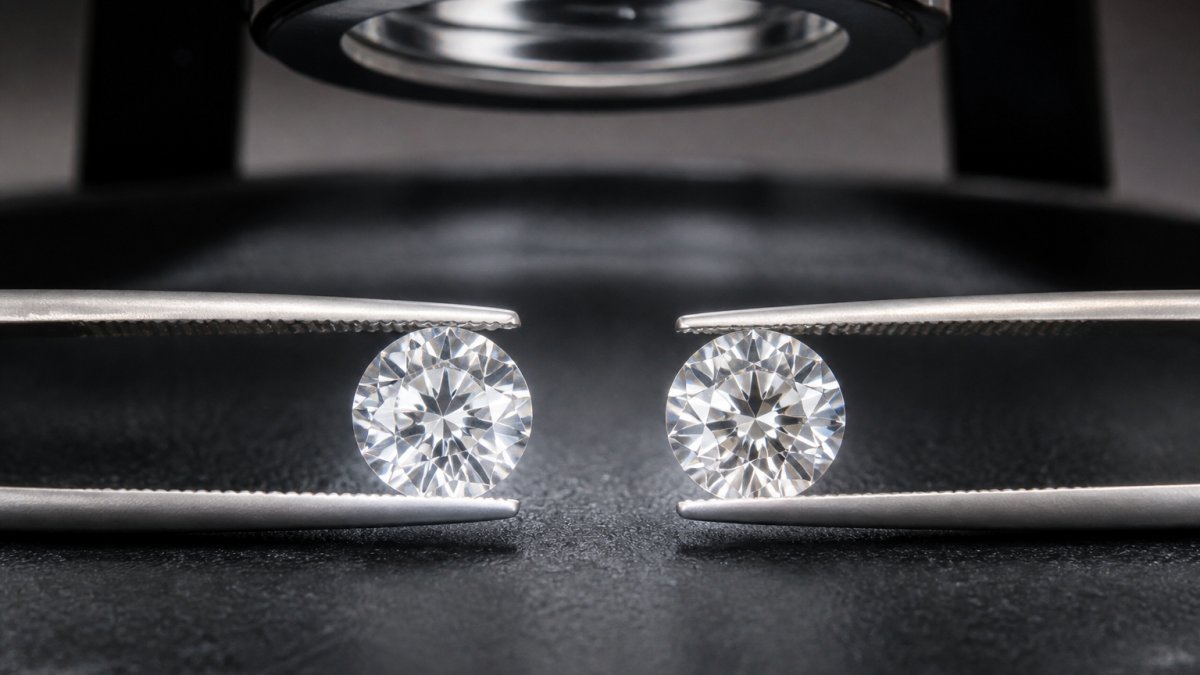
Physical and chemical composition is identical.
Production method differs fundamentally.
Cost structure reflects this production difference. Mining requires exploration, extraction, processing, and global supply chains. Lab production requires controlled facilities, energy, and raw materials.
4 CT Emerald Cut Lab Diamond Stud Earrings in 14K Yellow Gold →
Environmental impact depends on energy sourcing. Lab production with renewable energy is cleaner than mining; fossil-fuel-powered lab production narrows the advantage.
Investment and resale favor mined diamonds, which have stable or appreciating value because supply is fixed. Lab-grown diamonds will likely depreciate as supply increases and production becomes more efficient.
Certification and grading work the same way. Both receive grading reports from institutes like the Gemological Institute of America (GIA) documenting the 4 Cs and any treatments or enhancements.
How to Choose a Lab-Grown Diamond
Most guides stop at "check the 4Cs." That advice is correct but incomplete.
Step 1: Set your priority before you shop. Decide what matters most, size, cut quality, color, clarity, or the setting, and let that drive the search. Naming your priority up front prevents overpaying for a grade you will not notice.
Step 2: Read the grading report, not just the grade. A report from a recognized institute documents the stone's specifications. Look for:
- Carat weight stated to the hundredth of a carat.
- Color grade on the D-to-Z scale.
- Clarity grade on the FL-to-I3 scale.
- Cut grade (Excellent, Very Good, Good, Fair, Poor), the single biggest driver of visual sparkle.
- Measurements in millimeters, which reveal whether a stone faces up larger or smaller than its carat weight suggests.
- Polish and symmetry grades.
- Fluorescence notation, which can affect appearance in some lighting.
- Treatment and origin disclosures, including a lab-grown notation.
Step 3: Verify the inscription. Most certified lab-grown diamonds carry a microscopic laser inscription on the girdle matching the report number.
Step 4: Compare like-for-like. Two stones with identical grades can carry different prices. Pull several listings with the same 4Cs and compare.
Step 5: Confirm the seller's terms before you buy. This is where most buyers get surprised. Ask directly:
- Return window and conditions: How many days do you have, and must the stone be unworn with tags and paperwork intact?
- Warranty coverage: Does it cover the setting, the stone, or both, and for how long?
- Resizing and repair policies: Are these free, discounted, or excluded?
- Financing terms: If you use a payment plan, what are the terms and does the return policy still apply?
- Insurance guidance: Will the seller provide documentation an insurer will accept for a replacement-value policy?
Step 6: Think about the setting and metal. The stone is only part of the purchase. Metal choice (14K gold, platinum, and similar), setting style, and prong security affect appearance and durability.
Step 7: Confirm sourcing transparency. Ask where the stone was grown and whether the seller can document it. Reputable sellers provide this without hesitation.
Watch Out
A low price without a grading report is not a bargain, it is an unknown. Never buy a certified-grade stone without seeing the report first, and never accept a report from an unfamiliar grading lab without verifying it independently.
A quick pre-purchase checklist. Before you buy, confirm: the grading report is from a recognized institute; the inscription matches the report number; the 4Cs match what you were shown; the return window and warranty terms are in writing; and the seller can document the stone's origin. If any item is missing, pause.
Key Takeaway
Choosing well comes down to verification, not guesswork. Read the report, match the inscription, compare like-for-like, and get the return and warranty terms in writing before you buy.
Certification, Quality Standards, and What to Look For
Certification is non-negotiable when buying any diamond, lab-grown or mined. It's your proof of authenticity and quality.
Gemological Institute of America (GIA) reports are the gold standard. GIA grades diamonds using a rigorous, consistent methodology. A GIA report includes the 4 Cs, laser inscription details, and any treatments or enhancements.
American Gem Society (AGS) reports are equally reliable and sometimes preferred by professionals, using similar grading standards with detailed cut analysis GIA doesn't always include.
Quality grading standards for lab-grown diamonds are identical to those for mined diamonds. A VS1 clarity lab-grown diamond meets the same standard as a VS1 mined diamond. The grading scale doesn't change based on origin.
What to verify on your certificate:
- Carat weight (exact to the hundredth)
- Color grade (D-Z scale)
- Clarity grade (FL to I3 scale)
- Cut grade (Excellent, Very Good, Good, Fair, Poor)
- Laser inscription matching the report number
- Treatment disclosures (if any)
- Lab origin notation (for lab-grown diamonds)
Red flags to avoid:
- Diamonds without certification
- Vague or unfamiliar grading institutes
- Reports that lack detail or don't match the stone
- Sellers who can't explain the grading
When shopping at Databazaar, all lab-grown diamonds come quality-graded and verified, with full documentation so you can purchase with confidence.
Choosing a lab-grown diamond means balancing value, ethics, and long-term expectations. The benefits of buying lab grown diamonds are clear: genuine quality at a fraction of the cost, with transparent sourcing and lower environmental impact.
Frequently Asked Questions
Are lab-grown diamonds real diamonds?
Yes, lab-grown diamonds are real diamonds. They are physically, chemically, and optically identical to mined diamonds. The only difference is their origin: lab-grown diamonds are created in controlled laboratory environments using advanced technology, while mined diamonds form naturally underground over billions of years. Both possess the same crystal structure, hardness, and brilliance, making them indistinguishable to the naked eye. Gemological institutes grade lab-grown diamonds using the same standards (cut, color, clarity, and carat weight) as natural diamonds.
What are the main benefits of buying a lab-grown diamond?
Lab-grown diamonds offer several compelling benefits. They are less expensive than natural counterparts, allowing you to purchase larger stones or invest in higher-quality settings. They are conflict-free and ethically sourced, created without the environmental impact of mining. Lab-grown diamonds deliver the same visual beauty, sparkle, and durability as mined diamonds. They also provide greater budget flexibility, enabling you to maximize carat weight, cut quality, or customize your jewelry design without the premium cost associated with natural diamonds.
Are lab-grown diamonds a good investment?
Lab-grown diamonds are not ideal for long-term investment compared to mined diamonds. While they offer exceptional value at purchase, they typically recover less of their purchase price at resale compared to natural diamonds. However, they excel as consumer purchases for personal enjoyment and jewelry. If your priority is maximizing immediate visual impact, getting a larger stone, or owning beautiful, conflict-free jewelry without the premium price tag, lab-grown diamonds deliver outstanding value. For investment-grade holdings, natural diamonds remain the stronger choice.
What should you check before buying a lab-grown diamond?
Before purchasing a lab-grown diamond, verify certification from a reputable gemological institute confirming the diamond's quality grades (cut, color, clarity, and carat weight). Check the metal quality and setting durability of the jewelry piece. Review the retailer's return policy, warranty, and customer support, Databazaar offers 15-day returns and live voice support for peace of mind. Request detailed product specifications and consider your budget alongside the stone's dimensions to ensure you're getting the size and quality that match your needs.