 Skip to content


How to Choose the Perfect Engagement Ring: A 2026 Guide
Table of Contents
- Start With Your Partner's Personal Style and Preferences
- How to Choose a Diamond: Understanding the Four Cs
- Natural vs. Lab-Grown Diamonds: Which Is Right for You?
- Engagement Ring Styles and Setting Types
- How to Find Ring Size Secretly and Ensure Proper Fit
- Set Your Budget and Understand the True Value
- How to Choose the Perfect Engagement Ring: Your Decision Framework
- Care, Durability, and Long-Term Ownership
- Frequently Asked Questions
Last Updated: October 21, 2026
Start With Your Partner's Personal Style and Preferences
Understanding your partner's personal style is the foundation of choosing the perfect engagement ring. Before considering diamonds, metals, or settings, observe what they actually wear, jewelry, clothing, and whether their aesthetic is minimalist, bold, vintage, or modern.
The ring will be worn daily, so it should feel authentic to who they are, not what trends suggest.
- Observe their current jewelry preferences and metal choices
- Notice whether they prefer simple or ornate designs
- Consider their lifestyle and how active they are
How to Choose a Diamond: Understanding the Four Cs
Choosing a diamond starts with the Four Cs: cut, color, clarity, and carat weight. These factors determine quality, appearance, and value, but you also need a repeatable way to compare two stones.
Cut, Color, Clarity, and Carat Weight Explained
Cut is the most important of the Four Cs because it directly affects sparkle.
Color refers to the presence or absence of color in a diamond.
- D-F: Colorless (premium pricing)
- G-J: Near-colorless (excellent value)
- K and below: Faint to light color (noticeably warm)
Clarity measures inclusions or blemishes inside the diamond. FL and IF grades are rare and expensive, while VS1 and VS2 offer an excellent balance because inclusions are not visible to the naked eye.
Carat weight refers to how much a diamond weighs; one carat equals 200 milligrams.
A Repeatable Method for Comparing Two Diamonds
Use this checklist every time you compare stones, in a store or online.
- Read the grading report first. Confirm the lab, the report number, and that the report matches the stone. Compare cut grade, polish, and symmetry.
- Check the cut grade before anything else. If one stone is Excellent and the other Very Good, the Excellent stone usually wins on sparkle even if it is smaller or lower in color.
- Look at the clarity plot. An inclusion under the table (the flat top) is more visible than one near the girdle, so prefer stones with inclusions off-center or near the edge.
- Compare color in the metal you will use. A G-color stone in yellow gold looks warmer than the same stone in platinum. Judge color in the setting, not on a white tray.
- View both stones in three lighting conditions. Look under daylight, warm indoor light, and dim light. A well-cut stone stays lively in all three; a poorly cut stone goes flat in dim light.
- Check for fluorescence. Strong fluorescence can make a stone look milky in some lighting. Mild or faint fluorescence is usually harmless and can lower the price.
- Confirm the measurements, not just the carat. Two one-carat stones can differ in diameter. A stone with a slightly wider spread can look larger for the same weight.
How the Four Cs Trade Off Against Each Other
The Four Cs work together, so improving one usually means giving up another at a fixed budget.
- Raising carat weight at a fixed budget usually means accepting a lower color or clarity grade.
- Raising color or clarity at a fixed budget usually means a smaller stone.
- Cut is the one grade worth protecting, because it controls how the other three read to the eye.
Key TakeawayThe best comparison method is to fix your budget, protect the cut grade, then trade color, clarity, and carat against each other until the stone looks best in the setting you have chosen.
To see how different cut, color, and carat combinations look in finished rings, browse the Lab-Grown Diamond Jewelry collection or start with the Build Your Own Engagement Rings collection.
Natural vs. Lab-Grown Diamonds: Which Is Right for You?
Both natural and lab-grown diamonds are real diamonds with identical chemical compositions.
Lab-grown diamonds are typically more affordable than natural diamonds of comparable quality, carry no ethical mining concerns, and sparkle exactly like natural diamonds.
Natural diamonds appeal to those who value the rarity and geological history of a stone formed over billions of years, or who simply prefer the traditional choice.
- Lab-grown: Lower cost, ethical sourcing, identical physical properties
- Natural: Rare geological history, traditional choice, established market value
- Both: Real diamonds that will last forever
The choice comes down to personal values and budget.
Engagement Ring Styles and Setting Types
The setting is where the diamond or gemstone sits and how it's secured, and it dramatically affects the ring's overall appearance.
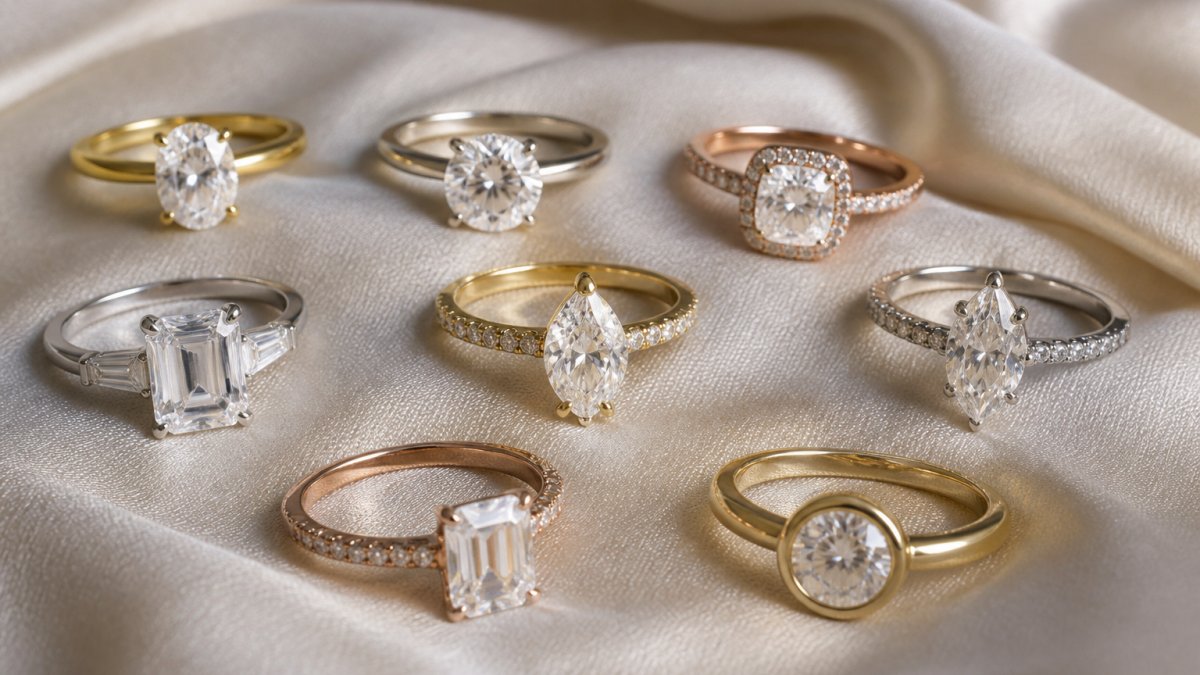
Popular Settings and Metal Choices
Solitaire is the most classic setting: a single stone on a simple band, letting the diamond be the focal point.
Three-stone rings feature a center diamond with a smaller stone on each side, often representing the past, present, and future.
Modern and contemporary settings feature sleek lines, geometric shapes, and minimalist designs for a forward-thinking aesthetic.
Metal choices include platinum, gold (yellow, white, or rose), and palladium. Each has different properties:
- Platinum: Extremely durable, naturally white, hypoallergenic, most expensive
- White gold: Durable, versatile, requires occasional replating to maintain bright white appearance
- Yellow gold: Classic, warm tone, durable, timeless appeal
The metal should complement your partner's skin tone and style.
How to Find Ring Size Secretly and Ensure Proper Fit
Finding ring size without revealing the surprise requires creativity and discretion.
Borrow a ring they wear daily on the ring finger of their left hand.
Trace a ring they own on paper and bring it to a jeweler for measurement.
Ask a trusted friend or family member who knows their ring size or can discreetly find out before purchase.
If the ring doesn't fit perfectly, most jewelers can resize it. Databazaar offers 15-day returns for flexibility.
Set Your Budget and Understand the True Value
Budget is a practical starting point for how to choose the perfect engagement ring, but a single number is not a plan. The total price is built from several line items, and understanding each one lets you move money toward what your partner will actually notice.
What Actually Drives the Total Price
- Center stone: Usually the largest line item. Price rises steeply with carat weight because larger rough is rarer, and it rises with higher color and clarity grades. Cut quality affects appearance more than price at a given grade.
- Setting style: A plain solitaire uses less metal and fewer small stones than a halo or three-stone design, so the setting cost scales with complexity and the number of accent stones.
- Metal type: Platinum typically costs more than white, yellow, or rose gold because it is denser and more expensive per ounce. Palladium sits between the two on cost.
Example Budget Tiers
These are illustrative allocations, not quotes. Actual prices vary by stone and setting.
- Entry tier: Allocate most of the budget to a well-cut stone in the 0.5-0.75 carat range, choose a simple solitaire in 14k gold, and accept a near-colorless grade (G-J) with eye-clean clarity (VS2-SI1).
- Mid tier: Move up to roughly 1 carat with excellent cut, keep a solitaire or add a thin halo, and choose 14k or 18k gold. This is where most buyers land.
- Upper tier: Fund a 1.5 carat or larger stone, a more complex setting, and platinum. At this level, certification and cut precision matter most because the stone is large enough to show flaws.
Where to Stretch and Where to Save
- Stretch on cut: Cut drives sparkle and is the one grade you should not compromise. An excellent-cut stone in a lower color grade outperforms a poorly cut stone in a higher grade.
- Save on color: G-J grades look colorless to most people in a set ring, especially in yellow or rose gold, which masks warmth.
- Save on clarity: Choose grades where inclusions are not visible to the naked eye (VS2 or SI1 with a clean center).
The Three-Months-Salary Rule Is Marketing, Not Math
That guideline was popularized by a mid-century diamond campaign, not by any financial standard. A sensible budget is one you can pay without borrowing at high interest or draining an emergency fund. Decide the number first, then build the ring backward from it.
Pro TipWrite down your total budget, then assign rough percentages: about 60-70% to the center stone, 15-25% to the setting and metal, and the remainder to certification, sizing, and a small buffer for resizing or insurance.
When you are ready to compare settings and stones against a real budget, start with the Build Your Own Engagement Rings collection or read the Build Your Own Engagement Ring Guide to see how each choice moves the total.
How to Choose the Perfect Engagement Ring: Your Decision Framework
Making the final decision requires synthesizing all these factors into a coherent choice. Use this framework to evaluate options systematically.
Step 1: Define Priority Factors
Identify what matters most to your partner.
Step 2: Set Your Parameters
Establish your budget range, preferred metal, and approximate carat weight or diamond size.
Step 3: Compare Specific Diamonds or Rings
Once you've narrowed to a few options, compare them directly.
Step 4: Verify Authenticity and Certification
Ensure any diamond comes with proper certification from a reputable grading lab. Databazaar provides certified diamonds with documentation of their Four Cs ratings, giving confidence in authenticity and quality.
Step 5: Make Your Choice
After evaluating options against your priorities and parameters, trust your instinct.
Care, Durability, and Long-Term Ownership
An engagement ring is meant to last a lifetime, so care and durability matter.
Regular maintenance keeps rings looking their best.
Have the ring professionally inspected every 1-2 years.
Avoid harsh chemicals, extreme temperatures, and hard impacts.
With proper care, an engagement ring maintains its beauty and structural integrity for generations.
Choosing the perfect engagement ring combines personal style, quality understanding, and practical decision-making.
Frequently Asked Questions
How do I find out my partner's ring size without asking directly?
Borrow a ring your partner already wears on their ring finger and have it sized at a jeweler, or ask a close friend or family member who might know. You can also trace the inside of an existing ring onto paper and bring it to a jeweler for sizing. If you're unsure, many jewelers offer free resizing within the first year, so you can choose the perfect engagement ring with confidence and adjust the fit later if needed.
What is the difference between natural and lab-grown diamonds for an engagement ring?
Natural diamonds form over billions of years deep in the Earth, while lab-grown diamonds are created in controlled environments in weeks or months. Both are chemically identical and graded using the same Four Cs standards. The choice between natural vs. lab-grown diamonds depends on your values around sustainability, budget, and personal preference—both are durable and beautiful for everyday wear.
How much should I spend on an engagement ring?
There's no single right answer—your budget depends on your income, financial goals, and priorities. A common guideline suggests spending what feels comfortable without straining your finances. Consider your total budget, then decide how much to allocate to the stone versus the setting. Databazaar offers flexible payment options with Affirm on orders over $50 to help you find a ring that fits both your vision and your budget.
What should I look for when buying a diamond engagement ring?
Prioritize the Four Cs: cut (how well the diamond is shaped), color (absence of color), clarity (absence of inclusions), and carat weight (size). Request a grading report from a reputable lab like the GIA to verify quality. Consider your partner's personal style, lifestyle and durability needs, and whether they prefer a natural or lab-grown diamond. Don't overlook the setting and metal type—they affect both appearance and long-term comfort.
Is a 2-carat engagement ring too flashy?
Not necessarily. Whether a 2-carat ring feels right depends entirely on your partner's personal style and lifestyle. Some people love a luminous, eye-catching stone; others prefer something more understated. Consider your partner's everyday wear habits, their fashion choices, and what makes them feel confident. The 'perfect' ring is one your partner loves wearing every day, regardless of carat weight.
What's the best diamond shape for an engagement ring?
The best diamond shape depends on your partner's personal style and preferences. Round brilliant diamonds are timeless and maximize sparkle; oval and pear shapes offer elegant, elongated profiles; cushion cuts provide vintage charm. Look at jewelry your partner already wears, save images of rings they love, or ask trusted friends about their preferences. The right shape is one that makes your partner feel beautiful and confident.
How do I know if a diamond is certified and authentic?
Always request a grading report from a reputable independent lab such as the GIA (Gemological Institute of America) or AGS (American Gem Society). This report verifies the diamond's authenticity and grades it on the Four Cs. Databazaar provides certified diamonds with grading reports to ensure confidence in your purchase. Never buy a diamond without documentation, and verify the report number directly with the lab if you have concerns.