 Skip to content


How to Spot Fake Perfume an Expert Guide
Spotting a fake perfume often comes down to the small details—flawless cellophane, crisp printing, and a sturdy, well-made box. A genuine fragrance will also have matching batch codes on both the box and the bottle and a complex, layered scent. These are the things counterfeiters almost always get wrong.
Your First Clue: Packaging and Presentation
Before you even get a whiff of the scent, the box and its wrapping offer the biggest clues about a perfume’s authenticity. Counterfeiters might get close with the bottle and scent, but they almost always cut corners on the packaging. This is where your detective work starts, and it’s usually where fakes give themselves away.
Think of authentic perfume packaging like a perfectly tailored suit—every detail is intentional and executed with precision. The first layer to check is the cellophane. It should be thick, tight, and sealed flawlessly. Luxury brands use high-quality cellophane that hugs the box snugly, almost like a second skin. If you see loose wrapping, messy glue spots, or uneven seams, that's an immediate red flag.
Inspecting the Box Material and Print Quality
Once you're past the cellophane, feel the box itself. Genuine perfume boxes are made from high-quality, sturdy paperboard designed to protect what's inside. It should feel substantial, not flimsy.
On the other hand, fakes are often packaged in cheap, thin material that feels lightweight or bends easily. Run your fingers over the surface; it should feel smooth and premium. The craftsmanship should feel luxurious, much like you'd find in high-end Tuscany leather bags, where the quality of the materials is everything.
The printing is another dead giveaway. Authentic boxes have sharp, clear text and perfectly rendered logos. Every letter should be crisp, with consistent font and spacing. Keep an eye out for:
- Misspellings or bad grammar: Luxury brands have intense quality control. A typo is a massive warning sign.
- Blurry or pixelated logos: The brand’s logo should be perfect. If the edges look fuzzy or the image is distorted, you're likely looking at a fake.
- Inconsistent font: Compare the font on the box to official images on the brand’s website. Fakes often use a typeface that's close but not quite right.
This quick infographic breaks down the three main things to check on perfume packaging: the wrapper, the box, and the text.
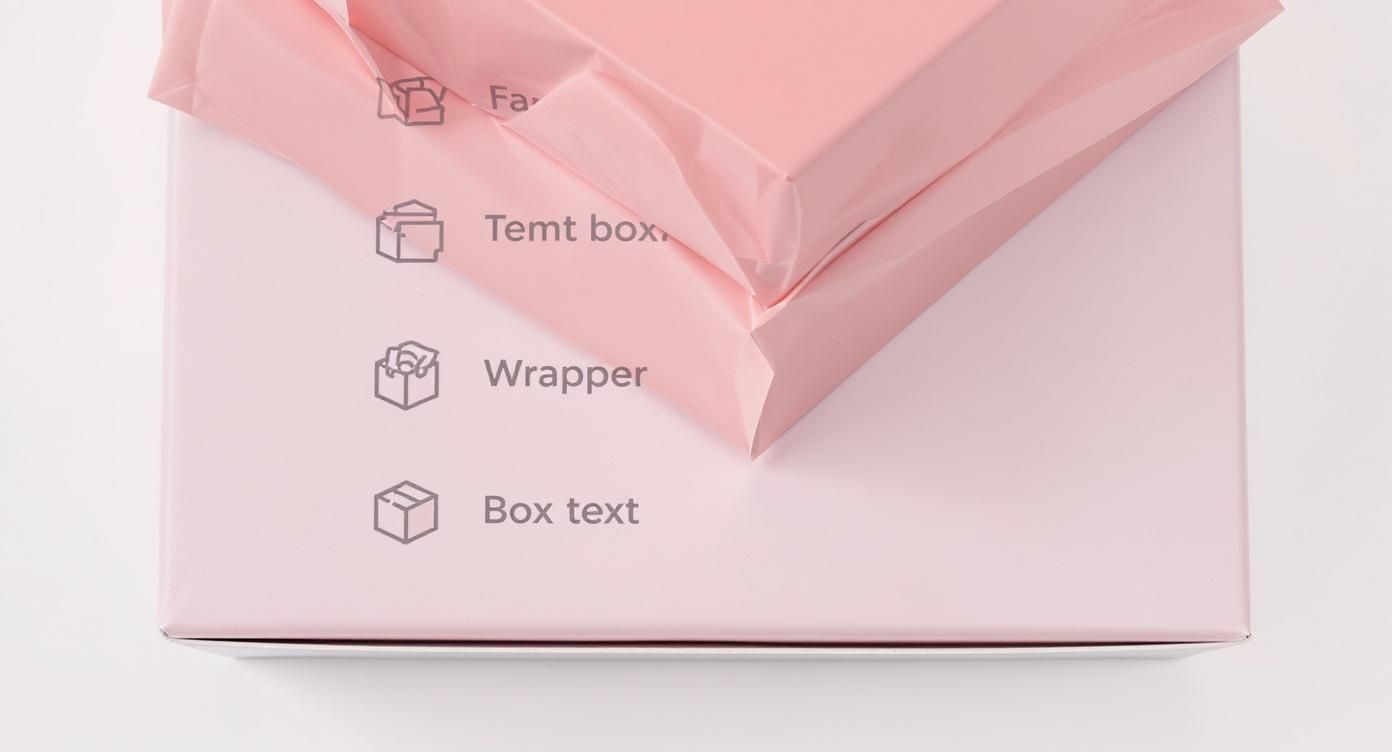
This visual guide is a great reminder that a close look at the outside is your best first defense against getting duped.
Verifying Text and Barcode Details
Beyond how it looks, the information printed on the box needs to be correct. Look for an ingredient list, the manufacturer's details, and a barcode. Authentic perfumes always list their ingredients to comply with regulations.
The barcode should be printed cleanly, usually on the bottom of the box. While you can use a scanner app to check it, a barcode alone isn't proof—they're easy to copy.
To give you a quick reference, here's a simple checklist comparing the packaging of real versus fake perfumes.
Authentic vs Fake Perfume Packaging Checklist
| Feature | Authentic Perfume | Potential Fake Perfume |
|---|---|---|
| Cellophane Wrap | Thick, tight, and flawlessly sealed. No excess glue. | Loose, crinkly, or poorly sealed. Obvious glue marks. |
| Box Material | High-quality, sturdy paperboard. Feels substantial. | Flimsy, thin cardboard that bends easily. |
| Print Quality | Sharp, crisp text and logos. Consistent font. | Blurry, pixelated, or fuzzy text. Misspellings. |
| Barcode | Cleanly printed and correctly placed. | Smudged, crooked, or missing. May not scan correctly. |
| Color & Finish | Colors match the official brand product. Smooth, premium finish. | Off-colors, inconsistent shades. Cheap or uneven finish. |
This table should help you quickly spot the most common red flags before you even open the box.
The overall presentation should scream luxury and attention to detail. If you want to get a better feel for what high-quality packaging looks like, it helps to review examples of genuine perfume products to build a mental library. By carefully checking these external elements, you can often spot a fake long before you make a disappointing—and potentially harmful—purchase.
Decoding the Hidden Codes and Serials
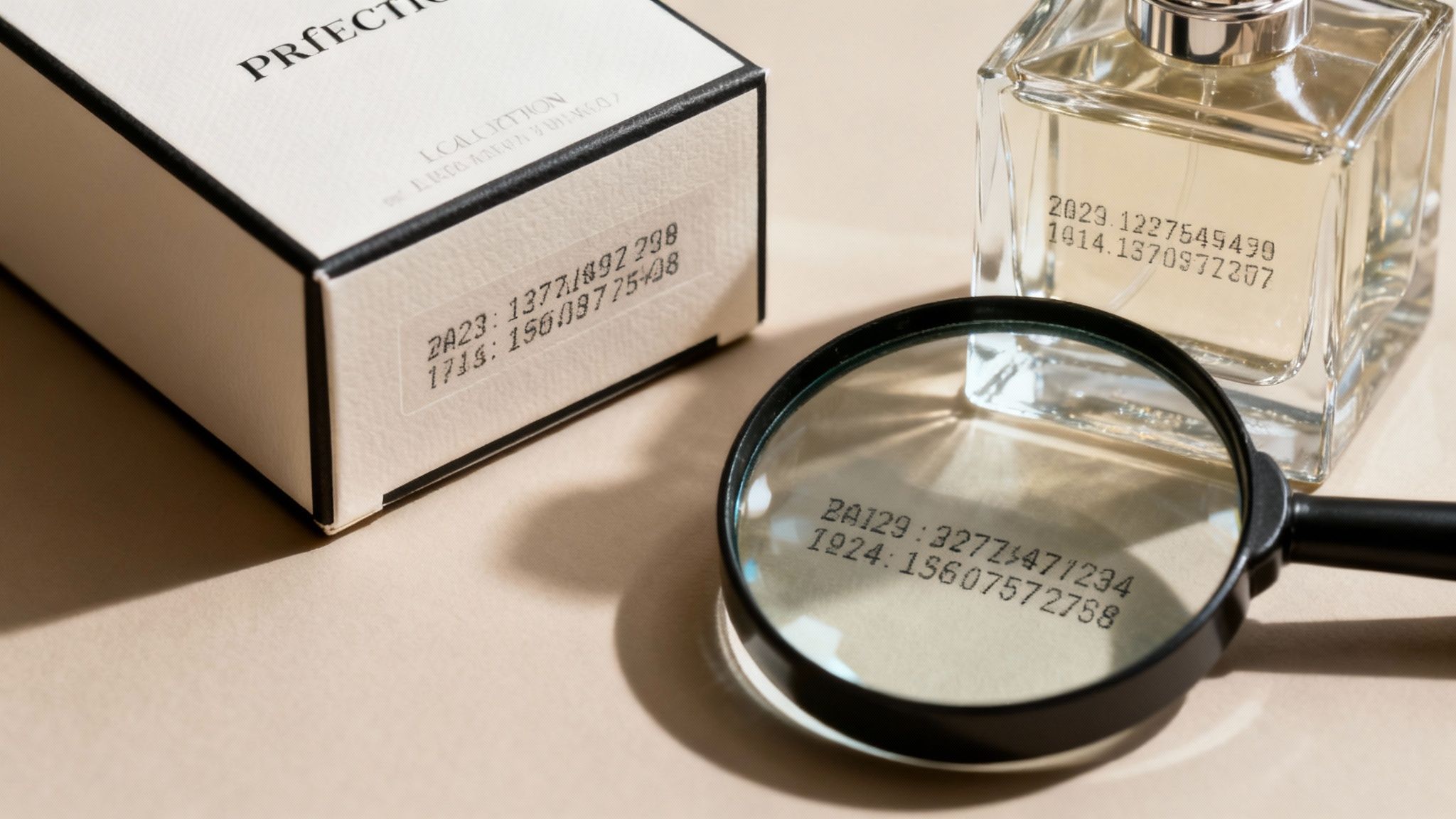
While the packaging gives you the first round of clues, the real proof is often hiding in plain sight: the batch code. This little string of numbers and letters is one of the most reliable ways to spot a fake, mainly because counterfeiters almost always mess this part up.
A batch code is just an internal tracking number manufacturers use to identify a specific production run. It tells them exactly when and where the fragrance was made, which is essential for quality control. You’ll usually find it printed or embossed on the bottom of the box.
The Unbreakable Rule of Matching Codes
Here's the most important check you can make. The batch code on the outer box must match the batch code on the perfume bottle itself. This is non-negotiable. Legitimate products are packaged as a single unit, so the codes will always be identical.
First, find the code on the box—it might be ink-jetted on or lightly pressed into the cardboard. Now, grab the bottle and look for the same code. It's usually etched into the glass on the bottom or printed discreetly near the base. They have to be a perfect match.
If the code on the box and the code on the bottle don't match, you're looking at a fake. No exceptions. This is one of the clearest red flags you can find.
Why does this happen? Counterfeiters often source their boxes and bottles from different places and slap them together. It's a simple mistake on their part, but it's a powerful tool for you.
Using Batch Codes to Check Production Dates
These codes do more than just match up; they can also tell you how old the perfume is. You can use online tools like CheckFresh or other batch code checkers to look up the manufacturing date. These sites keep large databases for thousands of brands.
Using them is easy:
- Find the Code: Jot down the batch code from your bottle or box (it'll look something like "N0J01" or "9353").
- Pick the Brand: Head to a verification site and select the correct fragrance brand from the dropdown menu.
- Enter the Code: Type it in and see what comes up.
The results should give you the month and year your perfume was bottled. This is great for confirming authenticity and also for checking freshness—a scent that's more than three years old might have lost some of its punch.
If the checker can't find the code or says it's invalid, that's another big reason to be suspicious. While these online tools aren't 100% foolproof, they add another strong layer of evidence to your investigation. Think of the batch code as the perfume's fingerprint; it's unique, and fakers have a tough time getting it right.
Inspecting the Bottle Cap and Sprayer Quality
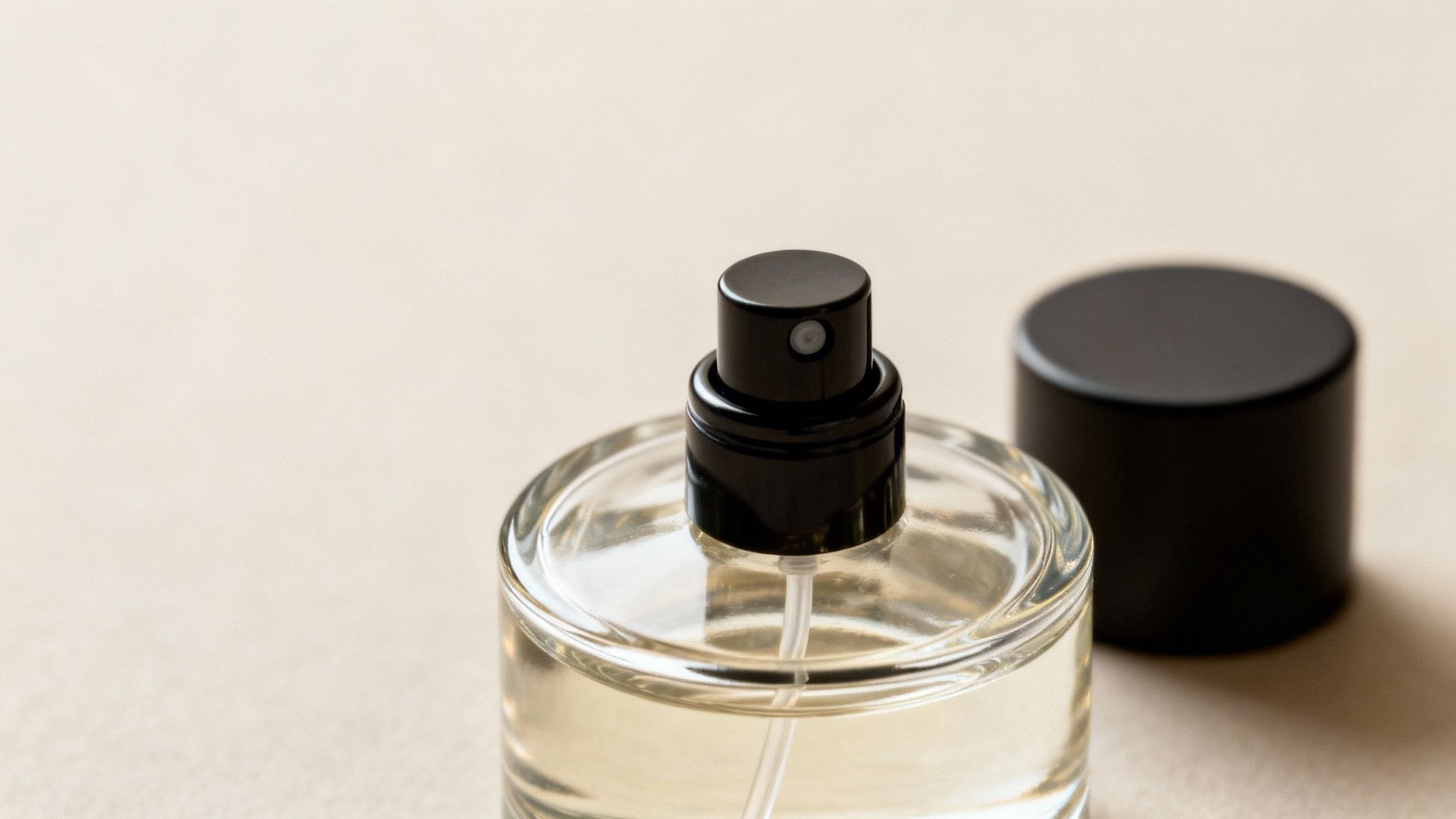
Alright, you’ve scrutinized the box and confirmed the codes. Now for the fun part: getting your hands on the bottle itself. This is where many counterfeiters slip up. They might be able to mimic a box, but replicating the heft, precision, and feel of a luxury perfume bottle is a whole different ballgame. The smallest flaws in the glass, cap, and sprayer are often the biggest giveaways.
Authentic perfume bottles are designed to be objects of art. The glass should feel utterly smooth and seamless. Run your fingers over the surface—you shouldn't feel any rough edges, visible seams from a cheap mold, or tiny air bubbles trapped inside the glass. These are hallmarks of low-cost production.
Evaluating the Cap Construction and Fit
The cap isn't just a lid; it's a carefully engineered component with a specific weight and feel. A genuine cap is substantial. It’s designed to click into place with satisfying precision, creating a perfect seal.
Go ahead and pick up the cap. Feel its weight. Counterfeiters almost always use cheap, lightweight plastic to cut costs, making the cap feel flimsy and insignificant. Now, place it on the bottle. It should slide on smoothly and lock into place with a crisp, audible click.
If the cap is loose, jiggles, or doesn’t sit perfectly centered, you’re almost certainly holding a fake. The quality should feel intentional. For example, the iconic design of Alien Eau de Parfum by Thierry Mugler has a unique cap that fits flawlessly—a detail that fakes rarely get right.
When checking the cap, look for these key things:
- Weight and Material: It should feel heavy and solid, not like hollow, cheap plastic.
- Symmetry and Alignment: The cap must sit perfectly straight and centered on the atomizer.
- Secure Fit: A real cap clicks or twists snugly into place, leaving no gaps.
A poorly fitting cap is a massive red flag. Luxury brands invest a fortune in creating a seamless user experience, and a wobbly, cheap-feeling cap completely shatters that illusion.
Analyzing the Sprayer and Internal Tube
Next up is the atomizer—the spray nozzle. This tiny part is another area where fakes reveal their shoddy construction. An authentic sprayer is designed to deliver a fine, even mist. It should work smoothly with a single press, never leaking or sputtering.
Fakes, on the other hand, often have clunky sprayers that shoot out the fragrance in a harsh jet or an uneven spurt. The nozzle itself might even look crooked or be made from a cheap-looking plastic that doesn’t match the bottle’s hardware.
Finally, peer inside the bottle and look at the plastic tube that draws the perfume up. In a high-end fragrance, this tube is usually almost invisible. It’s cut to the perfect length to just touch the bottom corner, making it as discreet as possible.
Counterfeiters use thicker, more obvious tubes that are often too long, causing them to bend awkwardly at the bottom. It’s a minor detail, but it’s a major sign of cheap manufacturing.
Here’s a quick breakdown of what to look for.
| Component | Authentic Perfume | Potential Fake Perfume |
|---|---|---|
| Bottle Glass | Smooth, seamless, and clear with no bubbles. | Rough seams, air bubbles, or an uneven finish. |
| Cap | Substantial weight, fits snugly, and clicks securely. | Lightweight, loose-fitting, and made of cheap plastic. |
| Sprayer | Produces a fine, even mist. Smooth operation. | Sputters, leaks, or sprays in a harsh jet. |
| Internal Tube | Thin, discreet, and cut to the perfect length. | Thick, obvious, and often bent or too long. |
By closely examining these physical details—the flawless glass, the weighty cap, the fine-mist sprayer, and the delicate internal tube—you can build a very strong case for whether a perfume is real or fake. These are the expensive details that counterfeiters just can't afford to get right.
Once you've scrutinized the box, codes, and bottle, it's time for the moment of truth: the scent itself. This is where counterfeiters almost always get caught. They might get the packaging close, but replicating the soul of a complex, layered fragrance is an art they simply can't master. The scent is the final boss, and it reveals everything about the quality and ingredients—or lack thereof.
A genuine perfume is a living thing on your skin. It's designed to tell a story, unfolding in three distinct acts known as the fragrance pyramid:
- Top Notes: This is the opening scene. You smell these bright, volatile notes right after you spray. They’re designed to grab your attention but usually fade within 5 to 15 minutes.
- Heart (or Middle) Notes: After the initial burst disappears, the main character emerges. These heart notes define the fragrance's personality and stick around for a few hours.
- Base Notes: Finally, the rich, deep notes come through to anchor the whole experience. These are the ones that linger on your skin for hours, creating that lasting impression.
This journey from the initial spritz to the final lingering scent is called the dry-down. It’s this evolution that gives a fragrance its depth and magic.
The Dead Giveaway: A One-Dimensional Scent
This is precisely where fakes fall flat. A counterfeit might hit you with a loud, aggressive blast that vaguely resembles the real deal's top notes. But that's it. The show is over before it even begins.
Instead of a beautiful, evolving dry-down, you get a harsh, one-dimensional chemical or alcohol smell that never changes. It just sits there, flat and linear, until it disappears completely. The complexity is gone because the high-quality, expensive ingredients that create those beautiful heart and base notes are nowhere to be found.
A genuine fragrance is a symphony; it has highs, lows, and a story to tell. A fake is a single, loud, and often unpleasant note that quickly fades to nothing.
Does It Last? Putting Longevity to the Test
Beyond complexity, staying power is a huge clue. Authentic fragrances, especially Eau de Parfum or Parfum concentrations, are built to last for hours. Those base notes are chosen specifically for their ability to cling to your skin, leaving a gorgeous, long-lasting trail.
Counterfeits, on the other hand, are famous for their disappearing act. They're typically made with cheap, watered-down alcohol and low-grade fragrance oils that evaporate in an hour or two, leaving behind nothing. If your new "luxury" perfume is gone before your lunch break, you've got a major red flag.
If you want to get a feel for what real complexity and longevity smell like, exploring curated lists of high-quality perfumes is a great way to train your nose. This guide to the best luxury fragrances for women, for example, can help you build a mental library of what genuine quality feels and smells like.
How to Do a Side-by-Side Comparison
The most definitive way to know for sure is to compare your suspicious perfume directly with a guaranteed authentic sample.
- Get a Real Sample: Head to an authorized retailer like Sephora, Nordstrom, or a major department store and ask for a sample. Have them spray it on a tester strip or, even better, directly on your skin.
- Test Your Perfume: On your other wrist, spray the perfume you're questioning.
- Compare and Wait: Smell both right after spraying. Then, keep smelling them every 30 minutes over the next few hours.
You aren't just looking for an identical opening. You're observing the journey. Does your perfume evolve the same way as the genuine one? Do you smell the same heart and base notes coming through? Or does it just smell sharp and then vanish? The difference will become crystal clear as time goes on.
Evaluating the Seller and the Price Tag
You've scrutinized the box, checked the batch codes, and tested the scent. But the final—and often most revealing—clue to a perfume's authenticity isn't in the bottle at all. It's in the context of the sale. Where you're buying it and what you're paying are massive tell-tale signs.
Let’s be blunt: an unbelievable price is almost always the first sign you're dealing with a fake.
Luxury brands pour millions into their image and tightly control who sells their products to maintain a specific price. Sure, you'll see sales at authorized retailers, but a brand-new, popular designer fragrance selling for 70-80% off retail? That’s a huge red flag. That kind of pricing just isn't sustainable for any legitimate business.
Vet Your Seller Thoroughly
The seller's credibility is everything. The absolute safest way to get the real deal is to buy directly from the brand’s official website or a major, authorized department store like Nordstrom, Macy's, or Sephora. These retailers have direct contracts with the fragrance houses, so authenticity is guaranteed.
But what about online marketplaces or independent sellers? This is where your inner detective needs to come out.
- Authorized Retailer Status: Look for a clear statement that they are an authorized dealer. If they aren't, and the prices are suspiciously low, proceed with extreme caution.
- Customer Reviews: Don't just look at star ratings. Read the reviews. A long history of positive feedback specifically mentioning product authenticity is a great sign. Be wary of sellers with very few reviews or a flood of generic, repetitive comments.
- Business Details: A real business has a professional-looking website, a clear and fair return policy, and actual contact information. If you can't find a phone number or a physical address, think twice.
The counterfeit market is a multi-billion dollar global problem, and it's easy to get caught up in it. The Organisation for Economic Co-operation and Development (OECD) reported that the trade in fake goods hit around $467 billion in 2021. Perfumes and cosmetics are prime targets. It’s not just about losing money, either—fake fragrances can contain dangerous chemicals because they completely bypass safety regulations.
The Danger Zone: Unofficial Marketplaces
It's tempting to snag a deal on an auction site, a social media marketplace, or from a street vendor. But these are the riskiest places to buy perfume, hands down. These sellers operate with virtually no oversight, making them a breeding ground for fakes.
The rule of thumb is simple: if the deal seems too good to be true, it almost certainly is. The fleeting satisfaction of a cheap purchase is not worth the disappointment and potential health risks of a fake product.
Flea markets and random street vendors are particularly notorious. They thrive on impulse buys and offer zero recourse if you realize you've been duped. No return policy, no customer service, and no way to prove where the product came from.
Becoming a savvy online shopper is a key skill for any fragrance lover. For a deeper look into this, check out the ultimate guide to buying luxury perfumes online, which offers more strategies for making sure you always get the real deal.
A Quick Checklist for Vetting Sellers and Prices
| Verification Point | Green Flag (Likely Authentic) | Red Flag (Likely Fake) |
|---|---|---|
| Price | Standard retail price or a modest discount (up to 30-40%) at a known store. | A massive, too-good-to-be-true discount (70% off or more) on a current fragrance. |
| Seller | Authorized retailer, official brand website, or a reputable department store. | Flea markets, street vendors, new marketplace accounts, or suspicious websites. |
| Online Presence | Professional website with clear contact info, return policy, and positive reviews. | No contact details, vague return policy, and a history of negative or no reviews. |
| Product Photos | High-quality, original photos of the actual product being sold. | Stock photos, blurry images, or pictures that don't match the description. |
Ultimately, protecting yourself from fakes boils down to a mix of careful inspection and smart shopping. By understanding the market and knowing where to look—and more importantly, where to avoid—you can build your fragrance collection with confidence, knowing every bottle is genuine.
Common Questions About Fake Perfumes
So, you've learned how to inspect the box, check the batch codes, and scrutinize the bottle. But even with all that knowledge, a few tricky questions often pop up. Let's tackle the most common concerns people have when they're on the hunt for authentic fragrances and trying to avoid the fakes.
Think of this as the final piece of the puzzle—the details that will give you total confidence in every bottle you buy.
Are Fake Perfumes Dangerous To Use?
In a word: yes. Using fake perfume can absolutely be dangerous. Authentic fragrances are made in controlled environments and have to meet strict safety regulations. Counterfeits, on the other hand, are churned out in unregulated labs with zero oversight.
This means they can be filled with a nasty cocktail of harmful, unapproved, and sometimes straight-up toxic chemicals. Spraying them on your skin comes with real risks:
- Skin Reactions: We're talking more than just a little itch. Ingredients like industrial solvents can cause rashes, chemical burns, and severe contact dermatitis.
- Respiratory Issues: When you inhale unknown chemicals, it can trigger anything from coughing fits to full-blown asthma attacks.
- Severe Allergic Reactions: Because the ingredients are undeclared, you could be exposing yourself to potent allergens that, in a worst-case scenario, might even lead to anaphylaxis.
At the end of the day, you have no idea what’s in that bottle. The money you save on a cheap counterfeit just isn't worth the potential health problems.
What Should I Do If I Accidentally Bought A Fake?
Realizing you've been duped is frustrating, but don't just toss the bottle in the bin. You have recourse. First things first, stop using the product immediately to avoid any potential skin or health issues.
Next, get in touch with the seller. If you bought it from an online marketplace like eBay or Amazon that has buyer protection, open a dispute and ask for a full refund. Back up your claim with clear evidence—take pictures of the shoddy packaging, the mismatched codes, or just describe how the scent is completely off. If you paid with a credit card, you can also file for a chargeback with your bank by explaining the goods were counterfeit.
It's also a huge help to report the seller. Flag them on whatever platform they used, and consider letting the real brand know. They actively track counterfeit rings, and your report helps protect other shoppers. To get a better sense of how the industry is fighting back, you can read up on industry efforts against counterfeits.
Are Perfume Testers Sometimes Fake?
It's not as common, but perfume testers can definitely be faked. A legitimate tester contains the exact same fragrance as the retail version. The only difference is the packaging—it usually comes in a plain white or brown box (or no box at all) and is clearly marked "TESTER - NOT FOR SALE."
Counterfeiters know people look for tester deals, so they create fakes and slap a "tester" label on them. All the same inspection rules apply here. Check the quality of the bottle, the atomizer, the cap, and the batch codes. A real tester from a luxury house like Dior will still feel like a premium product.
Be very skeptical of any seller with a massive, seemingly endless supply of testers for a super popular fragrance. That's often a red flag for mass-produced fakes being passed off as a good deal.
How Can I Tell If An Online Perfume Is Real?
Buying fragrances online requires a little extra homework since you can't hold the box in your hands. The single most important thing you can do is vet the seller. Stick to the brand’s official website or a well-known authorized retailer like Sephora or Nordstrom. Reputable online discounters with years of positive feedback are also a solid bet.
Before hitting "add to cart," run through this quick checklist:
- Read the Reviews: Dig for recent, detailed reviews that specifically talk about the product's authenticity.
- Check the Return Policy: A legitimate business will always have a clear, fair return policy. No returns is a huge red flag.
- Examine Product Photos: If the seller is just using blurry, generic stock photos, be wary. You want to see crisp, original images of the actual product.
Your best defense is always to buy from a source you trust. And if you're looking for inspiration on what to buy next from a verified source, check out our guide to the 10 best colognes for men to smell irresistible for some popular and authentic choices.
At Databazaar.com, we guarantee that every fragrance we sell is 100% authentic. Shop with confidence from our curated collection of luxury perfumes and enjoy the peace of mind that comes with our commitment to quality and customer satisfaction. Explore our selection today at https://www.databazaar.com.