Skip to content


How to Verify Diamond Authenticity Online in 2026
Table of Contents
- What You'll Need Before You Start
- Step 1: Diamond Certificate Verification With the Issuing Lab
- Step 2: How to Check a Diamond Certificate Number
- Step 3: Match the Report to the Physical Stone
- Step 4: How to Verify a Diamond Seller Online
- Step 5: Diamond Authenticity App and At-Home Test Limits
- How to Verify Diamond Authenticity When Buying Online
- When to Get Independent Verification
- Frequently Asked Questions
Last Updated: October 7, 2026
What You'll Need Before You Start
Learning how to verify diamond authenticity online starts with a few simple tools. None of them cost much, and most take only minutes to use.
A diamond grading report is a document from an independent lab that describes a stone's carat weight, cut, color, and clarity.
Gather these before you begin:
- The original paper report or a clear photo of it
- The report or certificate number
- A phone with a camera and a magnifier app
- A 10x jeweler's loupe
At Databazaar, we have sold certified fine jewelry since 1999. Below, we walk through each step in order.
Key Takeaway
The report number is the single most important detail. Without it, you cannot confirm that a report belongs to your stone.
Step 1: Diamond Certificate Verification With the Issuing Lab
Diamond certificate verification means matching the report number against the lab's own database. The lab that graded the stone is the only source that can confirm the report is real.
Start by finding the lab's name. Common grading labs include the Gemological Institute of America (GIA), the American Gem Society (AGS), and the International Gemological Institute (IGI).
Go to the lab's official website and find its report check page. The GIA Report Check tool lets you compare a report's details with the information stored in the lab's archive.
Check these fields against your paper report:
- Report number
- Shape and cutting style
- Carat weight
- Color grade and clarity grade
If any field does not match, treat that as a serious warning sign.
Step 2: How to Check a Diamond Certificate Number
To check a diamond certificate number, enter it into the issuing lab's database and confirm every listed field matches your document. A real report number returns a full record. A fake one usually returns nothing at all, or returns a record that belongs to a different stone.
Follow this workflow in order:
- Copy the number exactly, including any letters and leading zeros. Report numbers are case-sensitive on some lab portals.
- Open the lab's official lookup page directly by typing the domain, not by clicking a link the seller sent you. Phishing pages that mimic lab portals are a known pattern.
- Type the number into the search field and submit.
- Compare the returned record to your paper report line by line, using the field checklist below.
- Save a screenshot of the result, including the URL bar and the date, so you have a timestamped record.
- If the report has a QR code, scan it with your phone's camera and confirm it resolves to the same lab domain and the same report number. A QR code that opens a third-party page or a PDF hosted off the lab's site is a red flag.
Field-by-field comparison checklist
Do not stop at the report number. Compare every one of these fields between the online record and the paper report:
- Report number (exact match, including any suffix)
- Report date and issue date
- Shape and cutting style (for example, round brilliant vs. oval modified brilliant)
- Carat weight, to two decimal places
If even one field differs, treat the report as unverified until the lab confirms otherwise.
What to do when the record does not match
A mismatch is not always fraud. Common innocent causes include a typo when the seller transcribed the number, a report that was updated or reissued by the lab, or a stone that was recut and regraded. The correct response is the same in every case:
- Do not pay until the discrepancy is resolved in writing.
- Ask the seller for the original report PDF from the lab, not a photo of a printout.
- Contact the issuing lab directly through the phone number or email listed on the lab's own website, never through a contact link the seller provides.
- If the lab cannot confirm the record, walk away.
Watch Out
Watch for reused report numbers. A seller may copy a real number from a genuine stone and attach it to a different diamond. The number will check out online, but the stone will not match the report. This is why Step 3, matching the report to the physical stone, matters as much as the lookup itself.
A 2026 buying guide from Washington Diamond's diamond editorial advises entering the certificate number into the issuing laboratory's official database or scanning its secure QR code. Many modern reports include a QR code, which is faster and reduces typing errors, but only when the code resolves to the lab's own domain.
Step 3: Match the Report to the Physical Stone
Matching the report to the stone is where most online buyers stop too early. A valid report proves a diamond exists somewhere.
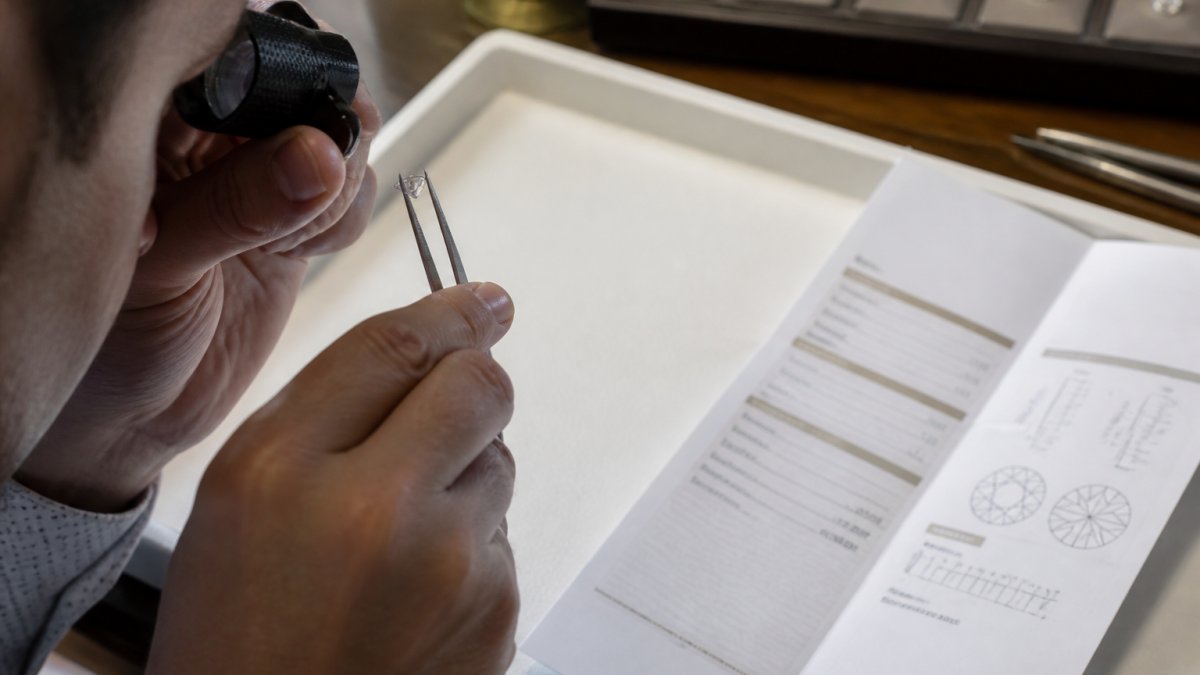
The most reliable link is the laser inscription. Most labs inscribe the report number on the diamond's girdle, the thin edge around its widest point.
Then confirm the physical traits:
- Weigh the stone and compare carat weight
- Check the measurements in millimeters against the report
- Compare the shape and proportions
- Look at the color and clarity under the same lighting
A 2026 guide from Leon Diamond's report-reading guide recommends checking the grading lab's credentials, matching the report to any laser inscription, and validating the report itself.
Step 4: How to Verify a Diamond Seller Online
To verify a diamond seller online, look for a real business history, clear return terms, and live human support. Scam sellers usually fail at least one of these.
Run through this checklist:
- Does the company list a physical business address?
- Is there a phone number with a real person on the line?
- Are return terms written in plain language?
- Does the site show a business history or founding date?
A seller who cannot answer basic questions about certification is a seller to avoid. Ask directly which lab graded the stone and request the report number before you pay.
Step 5: Diamond Authenticity App and At-Home Test Limits
A diamond authenticity app can help, but no app or home test can confirm a diamond on its own. Apps usually test light behavior or thermal response.
Here is what common tests can and cannot do:
| Test | What It Checks | Main Limit |
|---|---|---|
| Thermal tester | Heat conductivity | Fails on moissanite |
| Electrical tester | Electrical conductivity | Needs a clean, loose stone |
| UV light | Fluorescence | Many real diamonds show none |
| Magnifier app | Surface details | Cannot grade clarity |
| Breath test | Fog clearing speed | Unreliable on small stones |
A diamond simulant such as cubic zirconia or moissanite can pass some tests. Moissanite, in particular, often fools basic thermal testers.
Visual inspection still helps. Under a loupe, look at the facet edges and the sharpness of the girdle.
How to Verify Diamond Authenticity When Buying Online
When buying online, you cannot hold the stone before you pay, so your verification has to happen through documents, seller behavior, and the report itself. Ask for the report number before you commit, then verify it yourself in the lab's database. Never rely on a photo of a report alone, photos are easy to edit, and a PDF can be forged in minutes.
Natural, lab-grown, and imitation: three different things
A grading report confirms what a stone is. It does not automatically mean the stone is natural. Keep these distinctions straight:
- Natural diamonds formed in the earth and are mined.
- Lab-grown diamonds are real diamonds, same carbon structure, same optical properties, but grown in a laboratory. Reputable labs identify them as lab-grown on the report.
- Imitation stones such as cubic zirconia, moissanite, and glass are not diamonds at all. They should never appear on a diamond grading report.
A report from a major lab will state clearly whether the stone is natural or lab-grown, and will disclose any treatments such as laser drilling or fracture filling. If a listing claims 'certified diamond' without naming the lab or stating origin, that is a documentation gap, not a selling point.
How to recognize forged, altered, or reused certificates
Forged and altered reports are one of the most common online-purchase risks. Run this checklist before you trust any report:
- The report number returns no record, or returns a record with different measurements or grades.
- The PDF's embedded images look low-resolution or the fonts are inconsistent across the page.
- The lab's security features, hologram, watermark, microprint, or a QR code that resolves off the lab's domain, are missing or look printed rather than embedded.
- The same report number appears in more than one active listing on different sites. That is a strong signal of a reused number.
If two or more of these apply, treat the listing as high-risk regardless of how polished the product page looks.
Seller documentation and safe-purchase checklist
Before you pay, confirm the seller provides:
- The grading lab's name and the report number for the specific stone
- The original lab PDF, not a photo of a printout
- A written return policy with a clear window and the condition the stone must be in
- Secure payment options, credit card or a platform with buyer protection, not wire transfer or gift cards
- A physical business address and a phone number that reaches a person
A seller who cannot answer basic questions about certification is a seller to avoid. Ask directly which lab graded the stone and request the report number before you pay.
This is where a trusted retailer matters. At Databazaar, every certified diamond we list comes with its grading documentation. We offer flat rate shipping, 15-day returns, and live voice support, so you can ask questions and get real answers.
When to Get Independent Verification
Get an independent appraisal when the purchase is significant or when anything about the report feels off. A certified gemologist or independent appraiser can inspect the stone in person and confirm it matches the report.
Consider independent verification if:
- The stone is an engagement ring or a major purchase
- The seller is unfamiliar to you
- The report details do not match the stone
- You plan to insure the diamond
A second opinion costs little compared to the value of the stone. If a seller resists an independent check, that is your answer.
Pro Tip
Ask the appraiser to confirm the laser inscription and the report number in writing. That record protects you if you ever need to file a claim or resell the stone.
Frequently Asked Questions
How can I verify a diamond certificate online?
Go to the grading laboratory's official report-check page and enter the report number printed on the certificate. GIA Report Check, for example, lets you compare your report's information against the data archived in GIA's database. Confirm the carat weight, measurements, color, clarity, and cut details match your document exactly. A verified report confirms the certificate is genuine, not that the stone in front of you is the one it describes, so always pair this with a physical inspection.
Can a diamond report number prove a diamond is authentic?
No. A report number only proves the certificate itself was issued by that laboratory. It does not prove the stone you hold matches the report. Forged, altered, or reused certificates exist, so you need to confirm the laser inscription on the diamond's girdle matches the report number, then check that the carat weight, measurements, and proportions line up. Only a gemologist can confirm the physical stone matches the paperwork.
Is there a diamond authenticity app that can tell if my diamond is real?
Apps can scan a report number or QR code and pull up the lab's database entry, which speeds up certificate verification. They cannot analyze the stone itself. No phone app measures thermal conductivity, electrical conductivity, or refractive index, so it cannot separate a natural diamond from moissanite, cubic zirconia, or a lab-grown stone. Treat any app as a lookup tool, not a testing device.
How do I verify a diamond seller online before buying?
Check that the seller lists full grading reports from a reputable gemological laboratory for every stone, provides the report number so you can verify it yourself, and has a clear return policy. Look for a business history, real customer service contact options, and independent reviews. If a seller avoids sharing report numbers, pressures you to skip an independent appraisal, or prices a certified diamond far below market, walk away and buy elsewhere.
Buying a diamond online should feel exciting, not risky. The problem is that most shoppers never check the report number, and that one gap is where fakes slip through. At Databazaar, we have helped buyers shop with confidence since 1999, backed by certified diamonds, flat rate shipping, 15-day returns, and live voice support when you need a real person. Get started with Databazaar and verify your next diamond with total peace of mind.