Skip to content


Is It Safe to Buy Jewelry Online? A 2026 Guide
Table of Contents
- Why Online Jewelry Shopping Has Become Mainstream
- How to Tell If an Online Jewelry Store Is Legit
- Understanding Diamond Certification and Grading Reports
- Assessing Product Descriptions and Photographs
- Online Jewelry Return Policy and Buyer Protection
- Diamond Jewelry Shipping and Insurance Best Practices
- Pre-Purchase Verification Checklist
- Red Flags and Common Risks to Avoid
- Frequently Asked Questions
Last Updated: October 14, 2026
Why Online Jewelry Shopping Has Become Mainstream
When you buy jewelry online, you're engaging in a practice that has transformed from a risky gamble into a mainstream shopping method. The shift reflects real changes in how retailers operate and how consumers verify authenticity.
Online jewelry shopping offers convenience that physical stores cannot match. Customers browse collections from home, compare details across multiple retailers, and make purchases on their own schedule.
Databazaar has served as a trusted online jewelry destination since 1999, demonstrating that established retailers can build lasting customer relationships through transparent practices and reliable service.
This guide covers the essential checks that separate legitimate online jewelry retailers from unreliable ones. Readers will learn how to verify gemstone authenticity, assess return policies, and recognize trustworthy sellers before spending money.
How to Tell If an Online Jewelry Store Is Legit
Determining whether an online jewelry retailer is trustworthy requires examining multiple factors. No single check guarantees safety, but combining several verification steps creates confidence in the purchase.
Check for Business Registration and Longevity
Start by confirming the retailer's basic legitimacy. Search for the company name paired with "business registration" or "BBB" to find official records. A business that has operated for years typically has more accountability than a new startup with minimal history.
Look for the company's founding date on their website or in public records. Retailers that openly share their history signal confidence in their track record. Databazaar's presence as an established retailer since 1999 reflects the kind of longevity that suggests operational stability and customer-first practices.
Check whether the retailer maintains a physical address and contact information. Legitimate businesses display this information clearly. A phone number, email address, and mailing address reduce the likelihood of dealing with a fly-by-night operation.
Review Customer Feedback and Seller Reputation
Customer reviews reveal patterns that single transactions cannot. Read reviews across multiple platforms, Google, Trustpilot, and industry-specific sites, to identify consistent themes.
Look for reviews that address the concerns most relevant to jewelry purchases: authenticity verification, accurate product descriptions, shipping security, and return experiences. Patterns matter more than individual reviews.
Pay attention to how retailers respond to negative feedback. Companies that address concerns professionally and offer solutions demonstrate customer-focused values. Silence or dismissive responses suggest the retailer does not prioritize customer satisfaction.
Seller reputation scores on established platforms provide quick reference points. Retailers with ratings above 4 out of 5 stars across multiple sources show consistent customer satisfaction. Lower ratings warrant investigation into the specific complaints before purchasing.
Understanding Diamond Certification and Grading Reports
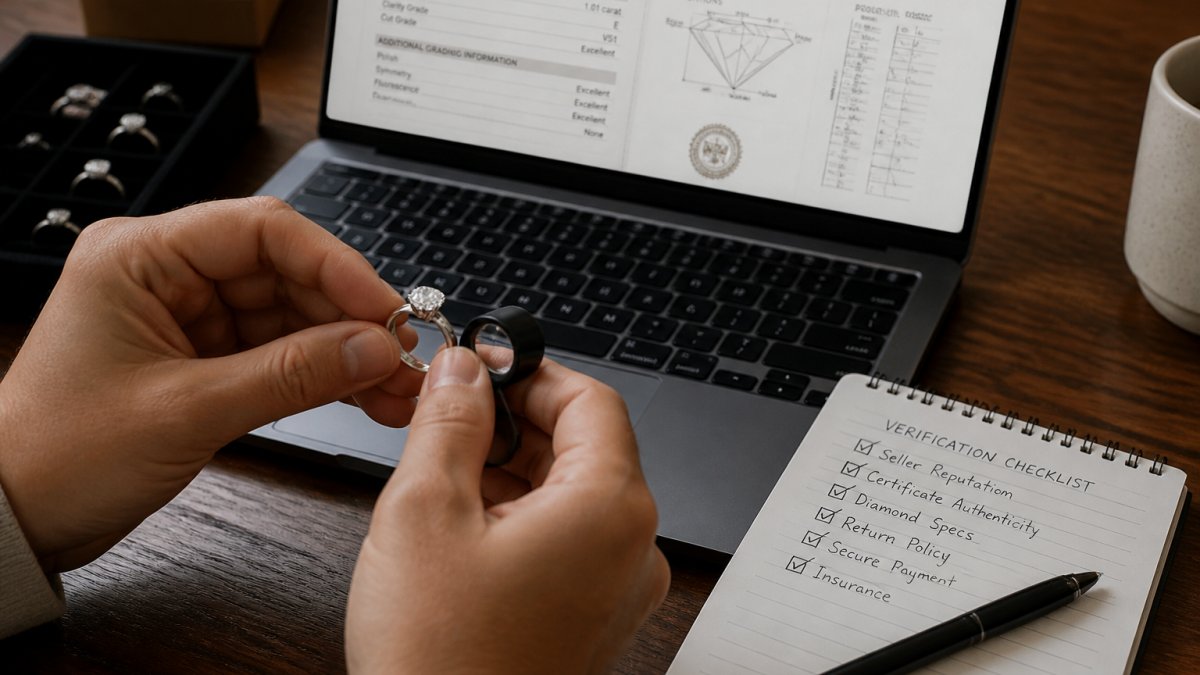
Diamond certification provides independent verification of a stone's characteristics. A grading report from a recognized lab documents the diamond's cut, color, clarity, and carat weight, the four factors that determine its value and quality (Diamond Quality Factors).
What to Look for in a Grading Report
A legitimate grading report includes the lab's name, report number, and date. Major labs include the Gemological Institute of America (GIA), the American Gem Society (AGS), and the International Gemological Institute (IGI).
The report should specify the diamond's exact measurements, weight, and color grade. Reputable labs use standardized grading scales that allow comparison across stones.
Request the grading report before purchase whenever possible. Legitimate retailers provide this documentation readily. If a seller cannot produce a report or claims the diamond does not require one, that's a significant warning sign.
Cross-reference the report number with the lab's official database. Most major labs maintain searchable records that allow verification of specific stones. This simple step confirms that the report actually exists and matches the diamond being sold.
Verifying Gemstone Authenticity and Quality
Beyond diamonds, other gemstones require verification of their authenticity and treatment status. A gemstone may be natural, lab-created, or treated to enhance its appearance. Reputable sellers disclose these details clearly.
Ask whether gemstones have undergone treatments such as heat treatment, irradiation, or coating. Treated stones cost less than untreated ones of similar appearance, but the treatment should be disclosed. Honest retailers explain these differences without hesitation.
For colored gemstones, request documentation of origin when relevant. Certain gemstones command higher prices based on geographic origin. A seller should provide evidence supporting origin claims rather than making unsupported assertions.
Verify that descriptions match the physical item. Request high-resolution photographs from multiple angles. Compare the photos to the product description to ensure the jewelry you receive matches what was advertised.
Assessing Product Descriptions and Photographs
Detailed product descriptions and clear photographs form the foundation of safe online jewelry purchases. These elements substitute for in-person inspection, making their accuracy critical.
Examine photographs taken under consistent lighting from multiple angles. Images should show the jewelry's front, back, sides, and any distinguishing features.
Check whether the description includes all relevant specifications: metal type, metal purity (such as 14K gold or platinum), gemstone type, gemstone treatments, dimensions, and weight.
Compare the product description to the photographs. Do the images match the stated specifications? Does the metal color match the claimed purity? Do gemstones appear consistent with their grade descriptions?
Look for information about craftsmanship and construction. Quality jewelry retailers explain how pieces are made, what materials are used, and how long they are expected to last.
Online Jewelry Return Policy and Buyer Protection
A strong return policy protects buyers who discover issues after purchase. Examine the policy details before committing to a purchase, as return terms vary significantly across retailers.
What a Strong Return Policy Should Include
Reliable retailers offer returns within a reasonable timeframe, typically 14 to 30 days. Longer return windows provide more time to inspect jewelry and determine fit.
The policy should allow returns for any reason, not just defects. Sometimes jewelry does not match expectations in person, even with accurate product descriptions.
Check whether the retailer covers return shipping costs or requires the buyer to pay. Full refunds minus shipping costs are standard. Policies that deduct restocking fees or other charges reduce the buyer's protection.
Understand the refund timeline. Legitimate retailers process refunds promptly after receiving returned items. A policy stating "refunds within 30 days of return receipt" is clearer than vague language about "processing refunds."
Ring Sizing and Fit Considerations
Ring sizing presents a unique challenge in online purchases. A ring that fits perfectly differs from one that is slightly loose or tight. Buyers cannot determine proper fit from photographs.
Reputable retailers offer free ring sizing or provide clear guidance on measuring at home. Some send sizing tools to help customers determine their correct size.
Before purchasing, measure an existing ring that fits properly. Most retailers provide sizing charts that correlate measurements to standard ring sizes.
Consider that ring size can fluctuate with temperature and time of day. Hands swell slightly in heat and toward evening. Taking measurements in consistent conditions provides more accurate results.
If a ring arrives in the wrong size, the return and reorder process should be straightforward.
Diamond Jewelry Shipping and Insurance Best Practices
Shipping valuable jewelry requires security measures beyond standard packaging. Understanding shipping options protects purchases from loss or damage in transit.
Choosing Insured and Tracked Delivery
Select shipping methods that include tracking and signature confirmation. Tracking allows buyers to monitor the package's location throughout delivery. Signature confirmation ensures that only the intended recipient receives the package.
Insured shipping protects the purchase value if the package is lost or damaged (Domestic Mail Manual S913 Insured Mail). Insurance typically covers the full declared value of the jewelry.
Compare shipping costs against the level of protection provided. Expedited shipping with full insurance costs more but reduces the time the package is in transit.
Reputable retailers include shipping insurance automatically on valuable orders. Databazaar's approach to flat-rate shipping on all orders reflects a commitment to transparent, accessible service. Clear communication about shipping costs and protection prevents surprises at checkout.
Understanding Shipping Insurance Coverage
Review the insurance policy details before finalizing the purchase. Legitimate insurance covers loss or damage from carrier mishandling but may exclude damage from natural disasters or customer-caused damage.
Understand the claims process. How long does the buyer have to report damage or loss? What documentation is required? Straightforward claims processes indicate that the retailer expects to stand behind their insurance coverage.
Take photographs of the jewelry upon arrival. Document any damage or defects immediately. These photos serve as evidence if an insurance claim becomes necessary.
Verify that the insurance covers the full replacement value, not just the purchase price. Some policies include deductibles or exclude certain types of damage. Reading the fine print prevents disappointment if a claim becomes necessary.
Pre-Purchase Verification Checklist
Before completing any online jewelry purchase, work through this checklist to confirm the retailer and product meet safety standards.
Verification Step |
What to Check |
Why It Matters |
|---|---|---|
Retailer Legitimacy |
Business registration, founding date, contact information |
Confirms the company operates legally and has accountability |
Customer Reviews |
Ratings across multiple platforms, specific feedback about jewelry purchases |
Reveals patterns in product quality and customer service |
Grading Reports |
Lab name, report number, specific measurements and grades |
Verifies diamond or gemstone authenticity and quality |
Product Descriptions |
Complete specifications, metal purity, gemstone details, dimensions |
Ensures you understand exactly what you are purchasing |
Photographs |
Multiple angles, clear lighting, close-up details |
Allows inspection of craftsmanship and actual appearance |
Return Policy |
Timeframe, reason restrictions, refund process, shipping coverage |
Protects you if the jewelry does not meet expectations |
Shipping Options |
Tracking, signature confirmation, insurance coverage |
Ensures secure delivery of valuable items |
Payment Security |
Encrypted checkout, trusted payment methods, buyer protection |
Protects your financial information and transaction |
Red Flags and Common Risks to Avoid
Certain warning signs indicate that an online jewelry retailer may not be trustworthy. Recognizing these patterns helps buyers avoid problematic purchases.
Avoid retailers that cannot produce grading reports or certificates for diamonds and gemstones. Legitimate sellers maintain documentation for every significant stone.
Be cautious of prices that seem significantly lower than comparable jewelry elsewhere.
Watch for vague product descriptions that lack specific details about materials, gemstone characteristics, or dimensions.
Avoid retailers with no physical address, phone number, or verifiable business history.
Be wary of pressure tactics that encourage rapid purchases. Legitimate retailers allow time for consideration and questions.
Examine payment options carefully. Reputable retailers accept major credit cards and established payment platforms that offer buyer protection.
Buying jewelry online carries real risks, but informed buyers can minimize them significantly.
Frequently Asked Questions
How can you tell if an online jewelry store is legitimate?
Check for business registration, established longevity (look for founding dates and business history), and verified customer reviews. Legitimate retailers display secure checkout indicators, offer clear contact information, and provide transparent return policies. Search for the retailer name alongside 'reviews' or 'complaints' to uncover customer experiences. Retailers that have earned industry recognition or have been in business for years typically demonstrate credibility and accountability to their customers.
How do you verify a diamond when buying jewelry online?
Request a grading report from a recognized gemological laboratory such as the Gemological Institute of America (GIA) or the American Gem Society (AGS). The report should detail the diamond's carat weight, color, clarity, and cut. Verify the report number on the laboratory's website to confirm authenticity. Compare the specifications in the product description with the official grading report. Ask the retailer for high-resolution photographs showing the diamond from multiple angles and any identifying marks or laser inscriptions.
What should you check in an online jewelry store's return policy?
Verify the return window duration, whether returns are free or require shipping costs, and what condition the item must be in. Check if the policy covers ring sizing, exchanges, and refunds. Confirm whether the retailer accepts returns on custom or personalized pieces. Understand the refund timeline and whether it includes original shipping costs. A strong return policy typically allows for returns and covers sizing adjustments, giving you confidence in your purchase.
Is it safe to buy a diamond ring online?
Yes, buying a diamond ring online is safe when you follow proper verification steps. Choose retailers with established reputations, verified certifications, and secure payment methods. Ensure the ring comes with a grading report and purchase protection through encrypted payment or credit card fraud protection. Select insured shipping with signature-required delivery. Many online retailers offer flexible return policies and sizing services, making the process secure and convenient. The key is due diligence before purchase and selecting a trustworthy seller.